

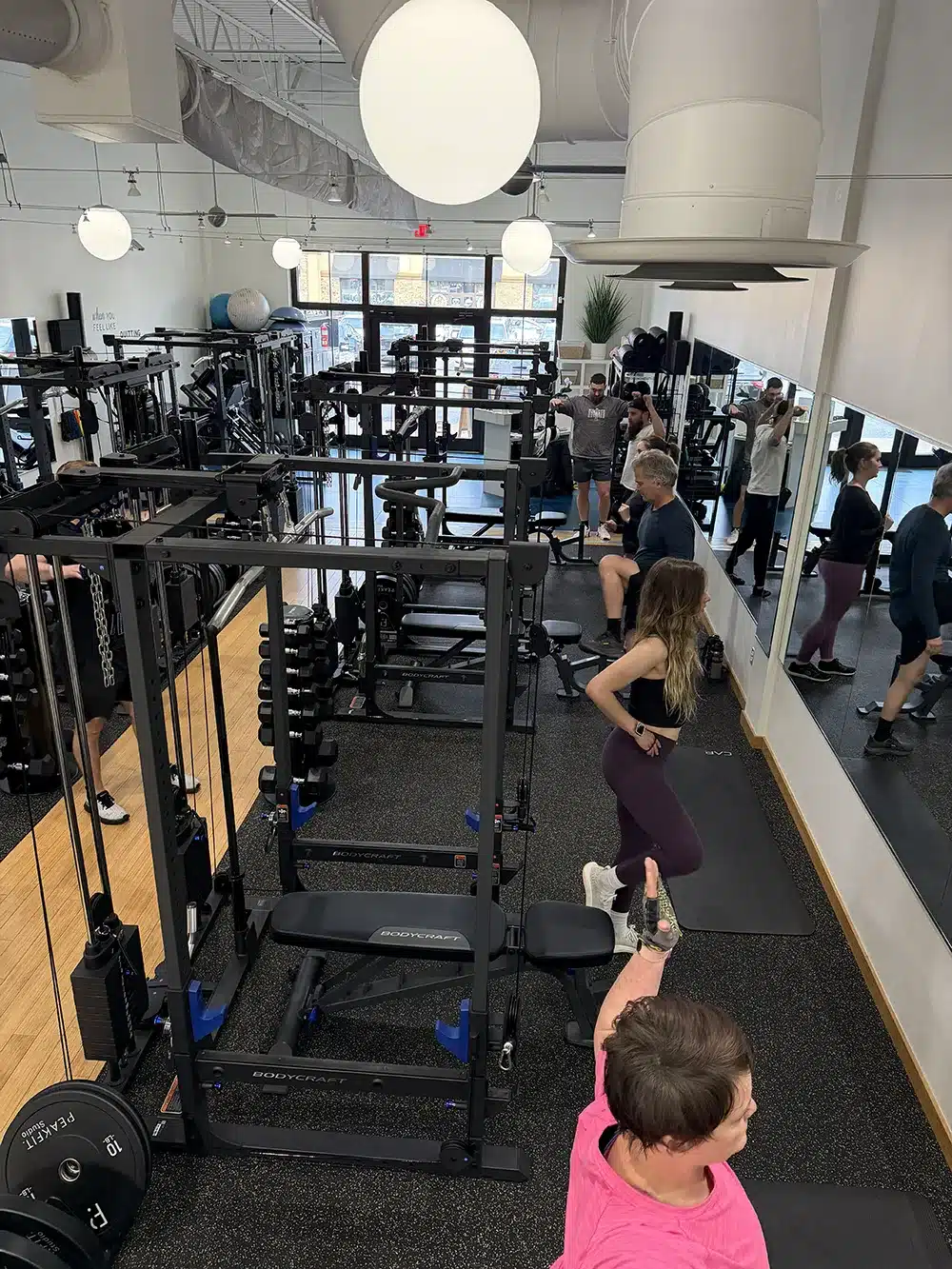
The standard pitch for group training focuses on programming, coaching, and cost. All of which are real. But the variable that actually drives most of the long-term results in group training is none of those things — it is the community effect. The simple fact that the same six to eight people show up to the same room every Tuesday and Thursday at 6am, week after week, year after year.
This sounds like a soft variable. It is not. The behavioral science is clear, and the impact compounds. Here is why community is the most underrated lever in fitness, and how it actually works.
The variable that beats programming quality
If you could run an experiment with two groups — one with optimal programming and weak adherence, one with average programming and strong adherence — the strong-adherence group would win every time. By a large margin. Adherence is the dominant variable in fitness outcomes by a wide gap, and almost nothing about a perfectly designed program matters if you do not actually do it.
This is well documented in the exercise science literature. Compliance to a moderately good program outperforms non-compliance to an ideal program by 3–5x over twelve months. Solo training, even well-programmed, runs into adherence problems for most adults. Community-based training solves the adherence problem structurally.
How community converts to consistency
Three mechanisms drive the community effect:
1. Expectation
When the same people are in the room with you every week, your absence is visible. Not punitively — just factually. Names get used. “Where was Jeremy on Tuesday?” This expectation is enough to convert a 70% adherence rate to a 90% adherence rate for most adults. That 20 percentage point swing, sustained over a year, produces dramatically different outcomes.
2. Identity
Solo training is something you do. Community training becomes something you are part of. The identity shift — from “person trying to work out” to “person in the Tuesday/Thursday small group” — is a powerful psychological lever. Identity-driven behavior is dramatically more durable than goal-driven behavior, because goals shift and identity does not.
3. Social proof of progression
You watch other people progress. They watch you progress. The room provides constant validation that the work is producing results — in real, observable, peer-level form. This is meaningfully different than watching results in your own mirror, which is harder to track week to week and easier to dismiss.
What the community effect looks like in practice
You start in a Tuesday 6am small group session. Six other people are there. Over the first month, you learn names. Over the second month, you start talking between sets. By month four, you are texting someone in the group when you have to miss a session.
By month six, you have a built-in social fabric you did not previously have. By month twelve, this group is one of the steadiest social structures in your life, and the workout is the by-product. You are not training to get fit. You are training because Tuesday and Thursday at 6am is what you do, with these people.
This is the dynamic that produces the highest retention rates of any fitness format. People stay because the room itself becomes meaningful, not because the workout is exceptional.
Why solo training cannot replicate this
Solo training, even with a great trainer, is a transactional relationship. The trainer cares about you, but they have ten other clients. They do not notice if you skip a session unless they had a session scheduled with you. There is no peer fabric. Your motivation has to be entirely self-generated.
Some adults can sustain self-generated motivation indefinitely. Most cannot. And the ones who cannot are not lacking discipline — they are missing the social architecture that humans use to sustain almost every long-term behavior.
How to leverage the community effect for results
If you are choosing a training format and you know you struggle with consistency, weight the community variable heavily. Specifically:
- Pick a studio where you will see the same coaches and clients on a recurring schedule
- Pick consistent time slots so you build relationships with the same room
- Make a point of learning at least three names in the first month
- Show up for at least the first two months before deciding whether the room is your room
The long-game outcome
The clients at PEAKFIT who have been with us the longest — three, four, five years — are not the most disciplined people you have ever met. They are people who found a room they like and showed up. That is the entire formula. The room did the work of sustaining them, week after week, until consistency became identity.
If you have been training alone and finding it hard to sustain, the answer is probably not better self-discipline. It is finding a room. Book an intro at PEAKFIT — meet the coaches, watch a session, and feel the room. If it is your room, you will know.




Functional Strength Training Asheville Adults Trust After 40
Key Takeaways Functional strength training focuses on movements that carry over directly into daily life, making it especially valuable for
Training With Your Spouse in Semi Private Personal Training
Key Takeaways Semi private personal training can work well for couples, but it requires honest conversations about pacing, goals, and
Best Personal Trainers for Women Over 50 in Asheville
Key Takeaways Women over 50 searching for a personal trainer in Asheville need more than a generic workout plan. The