

Key Takeaways
Choosing a personal trainer is a health decision, not just a fitness purchase. The right trainer holds a recognized certification, conducts a movement assessment before writing any program, and never pressures you into long contracts before earning your trust. Knowing the red flags ahead of time protects your time, your money, and your joints.
- Recognized certifications include NASM, NSCA, ACE, and ACSM — look for these by name.
- A qualified trainer assesses how you move before prescribing any exercise.
- No individualized program is a clear warning sign regardless of how polished the facility looks.
- High-pressure sales tactics and long prepaid contracts are red flags, not standard practice.
- Coaching style fit matters as much as credentials, especially for adults over 40.
What Actually Separates a Great Personal Trainer From a Mediocre One
A qualified personal trainer holds a nationally recognized certification, conducts a structured movement assessment at intake, writes programs specific to the individual client, and adjusts those programs as the client progresses. A mediocre trainer may do one or two of these things inconsistently. The difference shows up in results over months, not days, and in injury rates over years.
Most adults searching for a trainer in the Asheville and Arden area have already had at least one disappointing experience. They signed up somewhere, got handed a generic program, felt invisible in a crowd, and eventually stopped going. That pattern is not a personal failure. It is what happens when the training environment does not match the person. Understanding what a qualified trainer actually looks like on paper and in practice gives you a real filter to use before spending a dollar.
Certifications That Carry Real Weight
Nationally accredited certifications from organizations like NASM, NSCA, ACE, and ACSM require trainers to pass a proctored exam, demonstrate applied knowledge, and complete continuing education to maintain the credential. These are not the same as a weekend course or an online quiz.
Here is a quick reference for what each stands for and what it signals:
NASM (National Academy of Sports Medicine)
NASM certifications are widely recognized and built around a corrective exercise framework. A NASM-certified trainer understands how muscle imbalances develop and how to address them, which is particularly relevant for adults dealing with past injuries or chronic pain.
NSCA (National Strength and Conditioning Association)
The NSCA Certified Personal Trainer (NSCA-CPT) and its advanced credential the CSCS require a stronger background in exercise science. The NSCA credential tends to attract trainers who think deeply about programming and progressive overload rather than just putting clients through circuits.
ACE (American Council on Exercise)
ACE is one of the oldest and most recognized certifications in the field. ACE-certified trainers go through rigorous preparation in behavior change, nutrition basics, and exercise prescription. ACE also offers specialty certifications in medical fitness and older adult fitness.
ACSM (American College of Sports Medicine)
ACSM credentials are considered among the most clinically grounded in the industry. Trainers with ACSM certifications often work closely with medical populations and are well-versed in conditions like hypertension, osteoporosis, and post-surgical recovery.
According to the National Commission for Certifying Agencies (NCCA), accreditation of a certification body signals that the exam and the standard behind it have been independently reviewed for rigor. NASM, NSCA, ACE, and ACSM are all NCCA-accredited.
Dr. Cedric Bryant, exercise scientist and former chief science officer at ACE, has stated in published interviews that certification choice matters most when a trainer works with special populations, including older adults, people with chronic conditions, and those returning from injury.
What a Qualified Trainer Does in the First Session
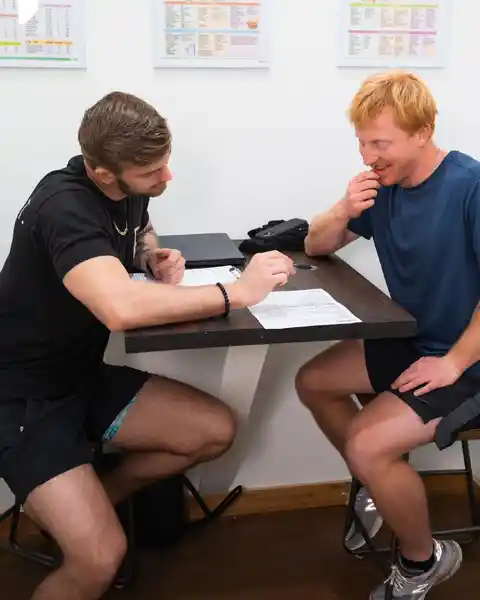
A qualified trainer spends the first session gathering information, not putting you through a workout. The intake process tells you almost everything you need to know about whether this person is actually equipped to help you.
A structured intake at minimum includes a health history review, a discussion of your current movement limitations and past injuries, and some form of movement screen. The movement screen does not have to be elaborate. It can involve basic patterns like a squat, a hinge, a push, and a pull. What matters is that the trainer watches how you move before prescribing how you should move.
At Peak Fit Studio in Arden, the intake process is built around understanding each client’s history, goals, and physical starting point before any programming begins. That approach reflects what exercise science consistently recommends. According to a 2019 review published in the Journal of Strength and Conditioning Research, individualized program design based on assessed movement patterns produces significantly better long-term adherence and injury prevention outcomes than generalized group templates.
Trainers who skip the assessment and go straight to a pre-written program are not adapting to you. They are fitting you into a template. For adults over 40 dealing with mobility changes, post-surgery recovery, or joint issues, that approach carries real risk. Functional movement patterns for adults require a careful eye on how existing limitations interact with exercise load and range of motion — something no template can account for alone.
Red Flags to Watch Before You Sign Anything
Several behaviors signal that a trainer or a training facility may not be the right fit, and some of them signal outright risk.
No individualized program
If a trainer cannot show you how your program differs from the person training next to you, it probably does not differ at all. Generic programs can produce some results for generally healthy adults, but they do not account for asymmetries, injury history, or the specific movement goals that matter most to your daily life. Adults over 40 benefit most from functional exercises built around everyday activities rather than one-size-fits-all templates.
No movement assessment at intake
Skipping the assessment is not a time-saving shortcut. It is an absence of professional process. A trainer who does not watch you move before loading you has no baseline to work from and no way to know whether what they are prescribing is appropriate for your body.
High-pressure contracts or large upfront packages
Legitimate trainers and studios want you to feel confident before committing. If you are being pressured to sign a long-term contract in the first conversation, that pressure is worth noticing. A studio confident in its product offers a free consultation or a trial before asking for a large financial commitment.
Vague or non-existent credentials
It is reasonable to ask a trainer directly: what certification do you hold and is it current? A qualified trainer will answer without hesitation. Evasiveness on this question is a clear signal.
Cookie-cutter nutrition advice without qualification
Personal trainers are not licensed dietitians. A trainer who builds a detailed meal plan with caloric targets and macro breakdowns without a registered dietitian credential or a formal nutrition coaching certification may be operating outside their scope. General lifestyle guidance is appropriate. Clinical nutrition intervention is not.
Dr. William Kramer, professor of human physiology at the University of Connecticut and longtime contributor to NSCA research, has noted in peer-reviewed publications that trainer scope of practice violations are among the most common issues reported in fitness-related adverse events.
Coaching Style and Fit for Adults Over 40
Credentials establish a floor. Coaching style determines whether you actually show up and do the work over time.
Adults over 40 training for longevity, recovery, or functional strength have specific needs that a skilled trainer recognizes. Programs focused on getting up off the floor easier, climbing stairs without discomfort, or staying strong for activities like yardwork and gardening require patience, attention to detail, and an ability to explain why each exercise matters. A trainer who defaults to high-intensity templates and ignores your feedback is not adjusting their coaching to your needs.
Questions worth asking before committing to a trainer include: How do you adjust a program when something causes pain? How do you track my progress over time? What happens if I hit a plateau? The answers reveal whether the trainer thinks systematically or reactively.
For adults in the Asheville



Functional Strength Training Asheville Adults Trust After 40
Key Takeaways Functional strength training focuses on movements that carry over directly into daily life, making it especially valuable for
Training With Your Spouse in Semi Private Personal Training
Key Takeaways Semi private personal training can work well for couples, but it requires honest conversations about pacing, goals, and
Best Personal Trainers for Women Over 50 in Asheville
Key Takeaways Women over 50 searching for a personal trainer in Asheville need more than a generic workout plan. The