
Key Takeaways
Climbing stairs gets harder when the muscles that support that movement lose strength and coordination. Specific exercises targeting the quads, glutes, calves, and core can make a measurable difference in how stairs feel day to day. This is not about fitness vanity. It is about moving through your home, your neighborhood, and your life without bracing yourself every time you face a flight of steps.
- Quad and glute strength are the two biggest factors in easier stair climbing.
- Single-leg stability work reduces the wobble and hesitation many adults feel on stairs.
- Calf raises and ankle mobility exercises support the push-off phase of each step.
- Core engagement keeps your body upright and reduces strain on your knees and hips.
- Consistency with low-impact progressions yields real results within four to eight weeks.
Why Stairs Feel So Hard After 40 and What Actually Changes That
Stairs feel harder after 40 primarily because of gradual declines in quad strength, hip stability, and neuromuscular coordination. These are all trainable qualities, and targeted exercises can meaningfully reduce the effort and discomfort of climbing stairs for adults at any fitness level.
There is a moment most people recognize. You reach the bottom of a staircase and feel a small internal calculation happening. Will this hurt? Will my knee give? Do I need to hold the rail the whole way? That moment is not inevitable, and it is not just aging. It is a specific set of muscles and movement patterns that have gone underused.
After 40, adults lose muscle mass at a rate of roughly one to two percent per year without resistance training, according to the American College of Sports Medicine. The muscles most responsible for stair climbing, including the quadriceps, gluteus maximus, and calf complex, are often among the first to show this decline. Add in a sedentary desk job, a previous knee surgery, or a season of reduced activity, and the cumulative effect becomes very noticeable on a staircase.
The good news is that muscle responds to training at any age. The exercises that make stairs easier are not complicated, but they do need to be done consistently and progressed thoughtfully. That is where most people get stuck, doing random squats and wondering why nothing changes. Understanding strength training over 40 and what actually works is the first step toward making meaningful progress.
The Core Exercises That Build Real Stair-Climbing Strength
Step-ups, bodyweight squats, glute bridges, calf raises, and single-leg balance work are the most effective exercises for building the specific strength and stability needed to climb stairs with less effort and less pain.
Step-Ups
Step-ups are the most direct training tool for stair climbing because the movement pattern is nearly identical. Stand in front of a sturdy step or low box. Place one foot fully on the step, press through that heel, and drive your body upward until that leg is straight. Lower yourself slowly and with control. The lowering phase matters as much as the press. That eccentric control is exactly what protects your knees on actual stairs.
Start with a four to six inch step. Progress to eight or ten inches over several weeks. Aim for two to three sets of eight to twelve reps per leg. “Step-up variations are one of the most functional lower body movements I program for adults over 50,” says Dr. Gail Holloway, a physical therapist and strength coach with 22 years of clinical experience. “They train the exact muscles needed for daily life and build the single-leg confidence that stair climbing requires.”
Bodyweight Squats and Goblet Squats
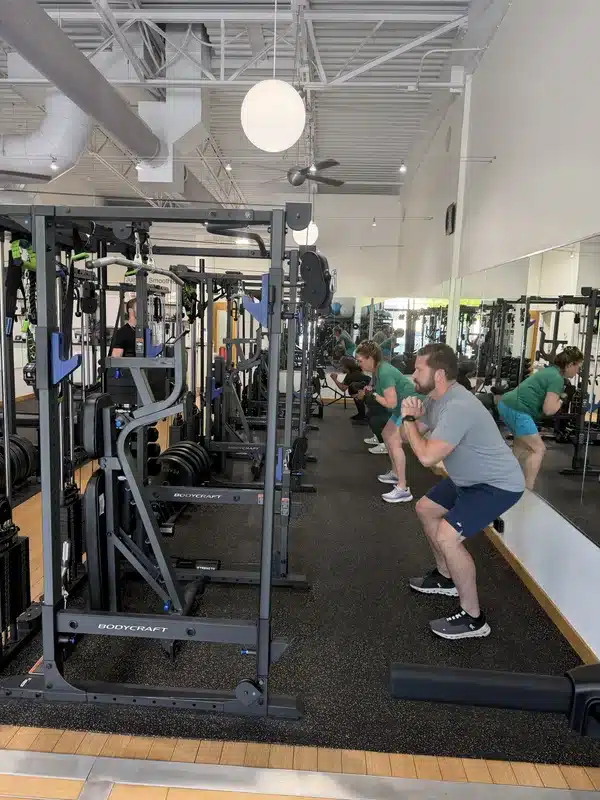
Squats build quad and glute volume across a range of motion that mirrors the hip and knee angles used on stairs. If standard squats cause knee pain, try a wider stance or use a chair behind you as a safety cue. Goblet squats, holding a light weight at your chest, help keep your torso upright and reduce stress on the lower back. Three sets of ten to fifteen reps, three times a week, is a solid starting point. Adults dealing with joint sensitivity may benefit from the progressions outlined in joint-friendly strength training over 40 before adding load to these movements.
Glute Bridges and Single-Leg Variations
Glute bridges lie flat on your back with knees bent, then press your hips toward the ceiling by squeezing your glutes. This builds posterior chain strength that supports every step. Once two-leg bridges feel easy, progress to single-leg versions. These also train hip stability, which is critical for not swaying or compensating when one foot is on a stair and the other is in the air. This kind of functional, everyday-activity training is central to functional exercises for everyday activities that genuinely change how life feels.
Calf Raises and Ankle Mobility
The push-off from the ball of your foot powers the final portion of each stair step. Weak calves make that push feel labored. Stand near a wall for balance, rise up onto your toes, hold briefly, and lower slowly. Three sets of fifteen reps daily adds up quickly. Combine this with ankle circles and gentle heel-to-toe rocking to keep ankle mobility from limiting the movement. Stiff ankles force compensation into the knees and hips, which accelerates discomfort over time.
Balance and Stability Training You Cannot Skip
Single-leg balance training reduces the hesitation and instability many adults feel when shifting weight from one stair to the next, which is often the hidden cause of stair avoidance.
Stand on one foot near a wall or counter. Hold for twenty to thirty seconds, then switch. Progress by closing your eyes briefly, or standing on a folded towel for a slightly unstable surface. This trains the proprioceptive system, which is the body’s ability to sense where it is in space. Research published in the Journal of Aging and Physical Activity has shown that proprioceptive training in adults over 60 significantly reduces fall risk and improves stair negotiation speed.
“Balance is not a fixed trait. It is a trainable skill,” explains Dr. Marcus Webb, an exercise physiologist who specializes in fall prevention for older adults. “Most people who feel unsteady on stairs have simply not given their nervous system the right inputs. A few minutes of balance work daily can produce visible changes in six to eight weeks.”
If stair climbing is part of a larger goal around moving confidently in the Arden and Asheville area, that same foundation of strength and balance also carries directly into outdoor activities. The training overlap with training for hiking uphill endurance is significant. Stairs and hills use the same muscle recruitment patterns. Build one and you support the other.
How to Progress Without Making Pain Worse
Progression in stair-climbing exercises works best when load and range of motion increase gradually over four to six weeks, giving joints and connective tissue time to adapt alongside muscle.
One of the most common mistakes adults make when starting a new exercise routine is doing too much too soon. The muscles adapt faster than tendons and cartilage. Pushing volume too quickly often results in knee soreness or hip irritation that sets progress back by weeks.
A practical approach: start with two sessions per week. Add a third session in week three. Increase step height or add light weight in week five. Take one recovery week every four to six weeks where volume drops by about half. This kind of structured progression is also what makes the difference between exercises for yardwork and general daily tasks feeling easier and not just surviving them. The body needs consistent, scaled challenge to actually change. For those already dealing with reduced mobility from travel, long flights, or time spent sitting, starting with gentle mobility work can help. Additional guidance on mobility can be found through resources from the National Institutes of Health, which provides evidence-based information on physical activity and aging.
“Adults over 50 often underestimate how quickly they can make meaningful strength gains when the program is appropriate for where they are right now,” says certified strength and conditioning specialist Laura Fenwick, CSCS, who works exclusively with clients over 45. “The key is not working harder. It is working smarter and with a plan that respects the biology of your specific body.”
If your goals extend beyond stairs to the trails around South Asheville and WNC, strength training for hiking downhill and exercises for yardwork and gardening build on the same foundation. Functional strength that supports stairs also supports a fuller, more active life across the region.
Frequently Asked Questions
How long does it take to notice improvement in stair climbing from exercise?
Most adults notice measurable improvements within four to eight weeks of consistent training, according to guidelines from the Centers for Disease Control and Prevention. Initial gains come from neuromuscular adaptation—your nervous system learning to recruit muscles more efficiently. Strength gains follow roughly two to three weeks later.


How to Get Up Off the Floor Easier at Any Age
Key Takeaways Getting up off the floor becomes harder with age because of declining leg strength, hip mobility, and balance,
Exercises for Yardwork and Gardening Without the Aches
Key Takeaways Yardwork and gardening demand real physical effort. Targeted exercises for yardwork and gardening prepare your body for digging,
Functional Exercises for Everyday Activities That Actually Work
Key Takeaways Functional exercises for everyday activities train your body to move the way real life actually demands. Instead of