
Key Takeaways
Travel stiffness is not just discomfort — it is your body signaling that circulation slowed, muscles shortened, and joints compressed during hours of sitting. A short sequence of targeted movements done before, during, and after travel can restore mobility, reduce soreness, and help you feel like yourself again within minutes.
- Hip flexors, thoracic spine, and calves are the primary areas that tighten during long flights and car rides.
- Movement breaks every 60 to 90 minutes of sitting prevent the worst of travel stiffness from setting up.
- Gentle active stretching outperforms static holds for restoring circulation and range of motion quickly.
- Adults over 40 recover from travel stiffness faster with consistent strength and mobility work done before the trip.
- A simple 10-minute routine done at your destination can reset your body and protect your joints the next day.
Why Travel Leaves Your Body Feeling Wrecked
Exercises for travel stiffness work best when you understand what actually causes the problem. Prolonged sitting compresses spinal discs, shortens hip flexors, and restricts blood flow to the lower limbs. Cabin pressure changes during flights reduce oxygen delivery to muscle tissue. Carrying luggage through airports loads one side of the body unevenly. All of this adds up fast, especially for adults over 40 whose connective tissue requires more time to adapt to positional stress. The good news is that stiffness from travel is almost entirely reversible with the right movements applied at the right time. You do not need a gym. You do not need equipment. You need to know what to do and when to do it.
The Movements That Undo Sitting Damage
Targeted mobility work addresses the three zones most punished by travel: the hips, the thoracic spine, and the ankles. Start with hip flexor stretches. A simple standing lunge with a posterior pelvic tilt held for 30 seconds per side begins reversing the shortened position your hip flexors held for hours. Follow that with thoracic rotations. Sit in a chair, cross your arms over your chest, and rotate slowly left and right through your mid-back. Ten repetitions each direction restore the spinal mobility that slumping eliminates. Finish with ankle circles and calf raises done standing at a wall. These drive blood back up from the lower legs and reduce the swelling that makes feet feel like lead after a long flight.
Movement Breaks During the Trip
Standing in the airplane aisle every 60 to 90 minutes is not optional for people who want to feel good at their destination. Walk to the back galley. Do 10 slow calf raises. Roll your shoulders backward five times. These micro-breaks prevent the deep stiffness that sets in when the same muscles stay loaded in the same position for four or more hours. In a car, pull over at rest stops. A two-minute walk and a hip flexor stretch costs you almost no time and pays off significantly when you arrive. “Prolonged static postures are one of the most underestimated stressors on the musculoskeletal system,” says Dr. Stuart McGill, professor emeritus of spine biomechanics at the University of Waterloo. “Short movement breaks interrupt that load cycle before tissue adaptation becomes problematic.”
A Practical Post-Travel Reset Routine
After you arrive, this sequence takes about 10 minutes and addresses every major area compressed during travel. Do it barefoot on the floor of your hotel room or living room before you do anything else.
Step 1: Cat-Cow (2 minutes)
On hands and knees, alternate between arching and rounding your spine slowly. This rehydrates spinal discs and wakes up the deep stabilizing muscles of your back. Ten slow repetitions with full breath involvement is enough.
Step 2: 90/90 Hip Stretch (2 minutes)
Sit on the floor with one leg in front and one behind, both bent to 90 degrees. Sit tall and hold for 45 seconds per side. This directly releases the external hip rotators that compress during seated travel.
Step 3: Wall Angels (2 minutes)
Stand with your back flat against a wall, arms bent at 90 degrees, and slowly slide them overhead while keeping contact with the wall. This reopens the thoracic spine and counters the forward-head posture that hours of screen time and headrest pressure create.
Step 4: Gentle Squats (2 minutes)
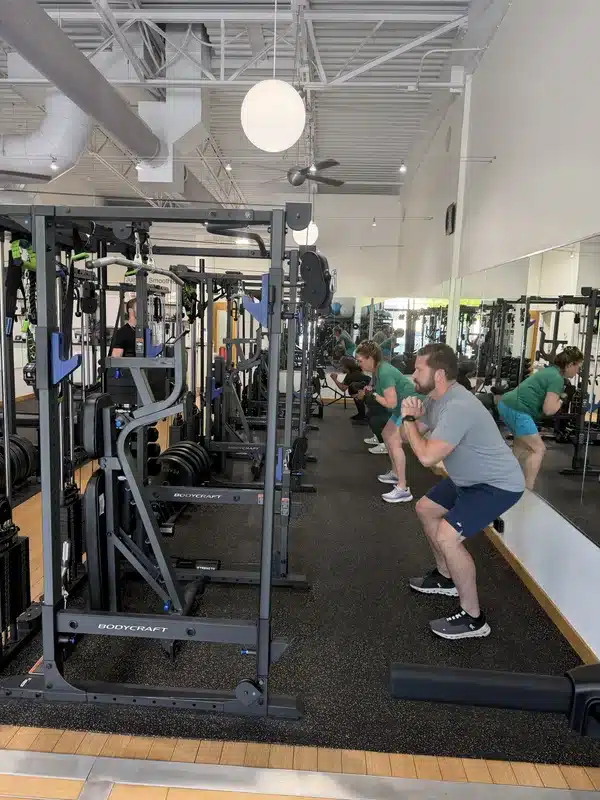
Ten slow bodyweight squats restore hip and knee circulation and remind your nervous system that your legs still work. Pause at the bottom for two seconds each rep. “Loaded movement, even at bodyweight, triggers synovial fluid production in the joints,” explains physical therapist and sports medicine specialist Dr. Kelly Starrett. “That is your body’s natural lubrication system, and travel shuts it down.” For adults who regularly travel and hike, building foundational lower body strength before the trip matters enormously. Resources on training for hiking uphill endurance and strength training for hiking downhill without wrecked knees explain how that groundwork protects your joints on both flat and technical terrain.
Why Strength Training Before You Travel Changes Everything
People who strength train consistently experience less travel stiffness than those who do not. This is not coincidence. Stronger muscles stabilize joints more efficiently, reducing the passive load on connective tissue during long periods of sitting. Better hip and glute strength means your pelvis maintains a more neutral position even in cramped airline seats. Stronger calves act as active pumps that keep blood moving in your legs without you thinking about it. For adults 40 and over, this makes a measurable difference in how quickly they recover after arrival. Joint-friendly strength training that builds muscle without aggravating existing wear and tear is exactly the kind of preparation that pays dividends the moment you board a plane. If you carry luggage through airports regularly, the specific demands of overhead lifting are worth preparing for as well. A guide on exercises to lift luggage overhead covers the shoulder and scapular stability work that prevents the injury that catches so many travelers off guard. If your travel brings you back to the mountains of Western North Carolina, the broader picture of fitness that supports your adventures in this region is worth exploring. Travel recovery and adventure readiness are two sides of the same preparation. “Adults who maintain consistent resistance training show significantly faster recovery from postural stressors, including prolonged sitting, compared to sedentary individuals of the same age,” notes exercise physiologist Dr. Wayne Westcott. For busy professionals who travel frequently, personal training for busy executives addresses how to maintain strength and mobility consistency even with an unpredictable schedule. The National Institutes of Health provides research-based guidance on exercise and movement physiology that supports these recovery principles. Supporting your recovery with proper hydration strategies is another factor that accelerates how quickly your body bounces back after the dehydrating effects of air travel. Additional information on musculoskeletal health during travel is available through the Occupational Safety and Health Administration guidelines for workplace ergonomics, which apply directly to extended sitting during travel.
Get Moving Again Before Stiffness Becomes the Norm
Exercises for travel stiffness are a short-term fix that points to a longer-term opportunity. If you find yourself wrecked after every flight or road trip, your body is telling you something about its baseline resilience. That is fixable. At Peak Fit Studio in Arden, the team works with adults over 40 who are tired of feeling stiff, sore, and slow after normal life activities like travel. Programs are built around your specific movement patterns, history, and goals, not a generic template pulled from a wall chart. Whether you need mobility work, foundational strength, or help building back after time away from exercise, there is a path forward that fits your life. Book Your Free Consultation at peakfit.studio/free-consultation/ or call (828) 620-7020.





Exercises to Lift Luggage Overhead Safely After 40
Key Takeaways Lifting luggage into an overhead bin is a real-world strength test that catches many adults off guard. The
PEAKFIT x Athleta Strength Class: What Happened and What’s Next
Arden’s Only Private Personal Training Studio for Adults 40+On July 25, 2026, PEAKFIT Studio partnered with Athleta for a free
Training for Hiking Uphill Endurance in Arden and Asheville
Key Takeaways Training for hiking uphill endurance means building the specific leg strength, cardiovascular capacity, and postural control that steep