
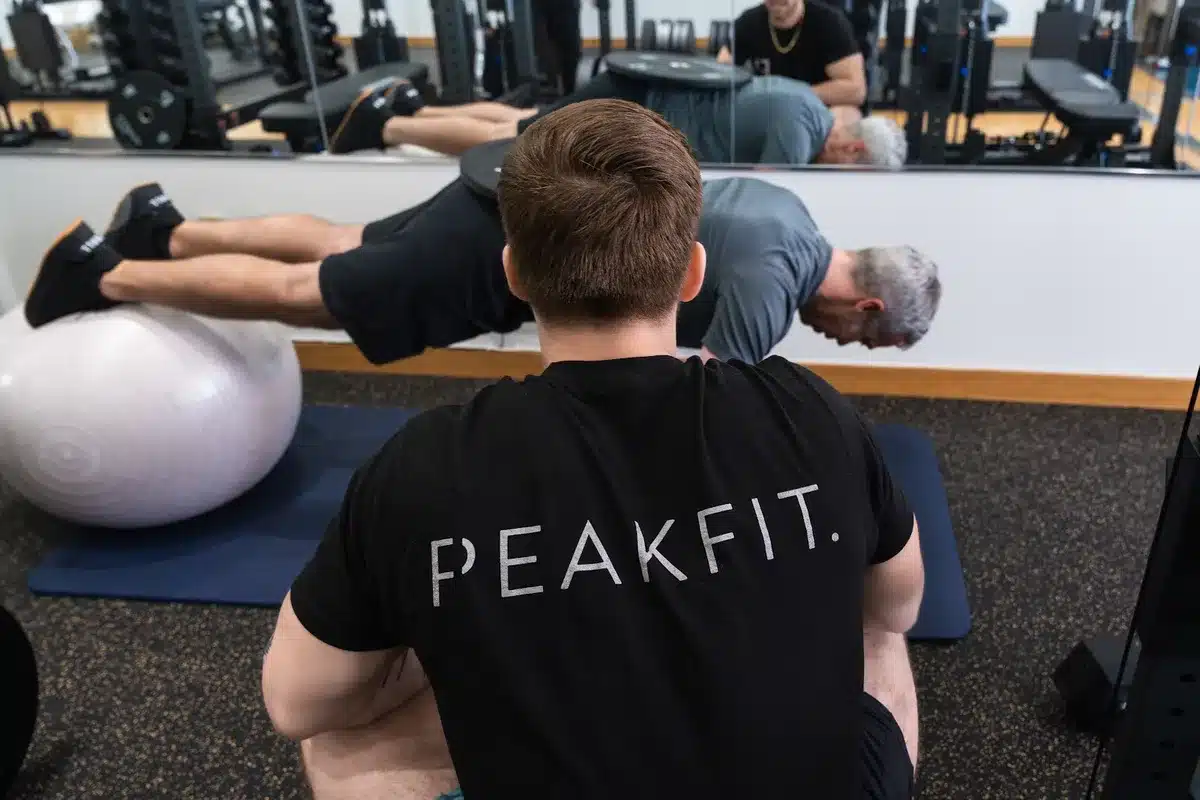

If your energy has shifted, your recovery has slowed, or staying lean feels harder than it used to, testosterone and exercise for men over 40 is a connection worth understanding. At Peak Fit Studio in Arden and South Asheville, we work with men in their 40s, 50s, 60s, and beyond who want to stay strong, feel capable, and maintain their vitality for the long haul. This guide covers what the research actually says and how you can put it to work.
Key Takeaways
Strategic exercise becomes even more important after 40 as testosterone naturally declines. The right training approach can help maintain healthy hormone levels and support long-term vitality.
- Testosterone levels drop 1-2% annually starting around age 30
- Resistance training provides the most significant hormonal benefits
- Recovery time becomes crucial as we age
- Compound movements outperform isolation exercises for hormone support
- Consistent moderate intensity beats sporadic high-intensity efforts
Why Your Energy Isn’t What It Used to Be
If you’re noticing less energy, slower recovery, or difficulty maintaining muscle mass despite staying active, you’re not imagining things. These changes often stem from naturally declining testosterone levels that begin in your thirties and accelerate through your forties and beyond. While this process is normal, it doesn’t mean you have to accept feeling less vital.
According to the American Urological Association, testosterone deficiency affects approximately 40% of men aged 45 and older. The symptoms extend beyond the physical to include mood changes, reduced motivation, and decreased quality of life. Understanding how exercise influences these hormone levels gives you concrete tools to maintain your health and energy as you age. The good news is that your body remains responsive to the right training stimulus, regardless of where you’re starting from.
Many men in the Asheville area come to us after years of pushing through fatigue, assuming it’s just part of getting older. Sometimes it is. But in many cases, a smarter, more targeted approach to training makes a measurable difference in how you feel day to day. That shift starts with understanding what exercise actually does to your hormones.
Does Resistance Training Increase Testosterone in Men Over 40?
This is one of the most common questions we hear, and the research gives a clear answer: yes, resistance training can increase testosterone levels in men over 40, both acutely after a session and over time with consistent training. A study published in the Journal of Strength and Conditioning Research found that resistance training produced more favorable hormonal responses than aerobic exercise alone in middle-aged men.
The mechanism matters here. When you challenge large muscle groups with meaningful resistance, your body responds by producing anabolic hormones, including testosterone, to support repair and adaptation. The greater the metabolic demand placed on your system during a training session, the stronger that hormonal signal tends to be. This is why a well-designed strength training program for men over 40 becomes increasingly valuable as we age rather than less.
Dr. William Kraemer, Professor of Kinesiology at the University of Connecticut and a leading exercise endocrinology researcher, explains it this way: “Resistance training, particularly when it involves large muscle groups and compound movements, creates the metabolic stress that can help maintain healthy testosterone levels in aging men.” That phrase, metabolic stress, is the key. Not every workout creates it. Volume, intensity, movement selection, and recovery all shape the hormonal outcome of your training.
For men who haven’t trained consistently in years, this is actually encouraging. The hormonal response to resistance training doesn’t require elite fitness. It requires an appropriate challenge relative to your current capacity, applied consistently over time.

Resistance Training and Testosterone Levels: What the Science Shows
The relationship between resistance training and testosterone levels in men over 40 is well-documented across multiple research institutions. The National Institute on Aging reports that men who engaged in resistance training three to four times per week showed better hormonal profiles than those who exercised daily or only once weekly. That finding cuts against two common mistakes: doing too little and doing too much.
Dr. Stuart Phillips, Professor of Kinesiology at McMaster University, notes: “The sweet spot for men over 40 appears to be moderate to high intensity resistance training performed consistently with adequate rest between sessions. This approach supports both muscle maintenance and hormonal health.” That word consistently appears in nearly every credible study on this topic. A single hard workout will produce a short-term testosterone spike. A sustained training habit produces structural hormonal adaptation over months and years.
Compound movements are the foundation of this approach. Squats, deadlifts, rows, and presses engage multiple large muscle groups simultaneously. That multi-joint demand creates the kind of whole-body metabolic response that single-joint isolation exercises simply cannot match. If your current routine leans heavily on machines that move you through a fixed path with minimal stabilization demand, you may be leaving significant hormonal benefit on the table.
Studies suggest that moderate to heavy loads, roughly 70 to 85 percent of your one-rep maximum, performed for six to twelve repetitions per set tend to produce the most favorable testosterone response. Progressive overload, gradually increasing the challenge over time, sustains that response as your body adapts. Proper form matters more than absolute weight, particularly as we age and joint health becomes a priority.
What Works Best for Men in Their 40s, 50s, and Beyond
The most effective exercise approach for supporting healthy testosterone levels combines strategic resistance training with adequate recovery. Not every training session needs to be punishing. In fact, for men over 40, chronically high training intensity without sufficient rest often backfires hormonally.
Training Frequency and Intensity That Get Results
Three to four resistance training sessions per week, spread across the week to allow recovery between sessions, is a well-supported starting structure. Each session should prioritize compound movements, build toward progressive overload over weeks and months, and leave you feeling worked but not wrecked. If you’re consistently limping into your next session still sore from the last one, that’s a signal your volume or intensity needs adjustment, not a sign you trained hard enough.
High-intensity, short-duration activities that challenge multiple muscle groups simultaneously tend to produce the most significant acute testosterone response. But for men in their 40s, 50s, and 60s, the goal isn’t to maximize any single session. It’s to build a training life you can sustain for decades. A program that keeps you healthy and progressing over five years will do far more for your hormonal health than six weeks of extreme effort followed by injury or burnout.
The Role of Cardio in Testosterone Health
Moderate cardiovascular exercise supports overall health and complements your resistance training without undermining hormonal balance. The concern arises with excessive endurance training. Very high volumes of steady-state cardio, think marathon training or daily long runs, have been associated with suppressed testosterone in some research. For most men over 40 in general fitness, moderate cardio two to three times per week alongside consistent strength work is a balanced and sustainable approach.
Recovery: The Missing Piece Most Men Overlook
Recovery isn’t passive. It’s when your body actually adapts to training and produces the beneficial hormonal responses you’re working toward. Sleep quality, stress management, and proper nutrition all play direct roles in maintaining healthy testosterone levels, independent of and in addition to the work you do in the gym.
A study in the Journal of the American Medical Association found that men who slept fewer than five hours per night had significantly lower testosterone levels than those who got seven to eight hours of quality sleep. That’s a substantial hormonal difference driven entirely by rest, not training. If you’re training consistently but sleeping poorly, you may be limiting your results in a way that no workout can compensate for.
Chronic stress produces cortisol, which competes directly with testosterone in the hormonal hierarchy. Managing your overall stress load, through adequate sleep, realistic training volume, and life-balance habits, is part of a complete hormonal health strategy. Many men focus entirely on what they do in the gym and overlook this half of the equation entirely.
Understanding signs of underrecovering matters more as we age. Working with a trainer who understands training load management for men over 40 helps you stay on the productive side of that line. Professional guidance becomes especially valuable for those who are starting over at 60 or returning to consistent exercise after a long break.
Nutrition’s Role in Testosterone and Exercise for Men Over 40
Exercise provides the hormonal stimulus. Nutrition provides the raw material. Both matter, and neither fully compensates for deficits in the other. Adequate protein supports muscle repair and the hormonal signaling that goes with it. Healthy fats, including cholesterol-containing foods, are literally the building blocks from which testosterone is synthesized. Severe caloric restriction, common in men who are trying to lose weight quickly, can suppress testosterone production even when training is consistent.
Understanding nutrition timing for strength after 40 adds another layer of precision. Getting adequate protein around your training sessions supports muscle protein synthesis and the recovery process. This doesn’t require elaborate supplementation. It requires consistent attention to the basics: enough total protein, enough total calories to support your activity level, and enough micronutrient variety to support overall metabolic function.
How to Start if You Haven’t Trained Consistently in Years
Your body can still respond positively to resistance training at any age. The research on this point is clear and encouraging. Men in their 60s and 70s show measurable hormonal and muscular adaptations to resistance training, often within eight to twelve weeks of consistent effort. The starting point doesn’t determine the outcome. The consistency and quality of the approach do.
Starting slowly with professional guidance is key. Your program needs to account for your current fitness level, any orthopedic history, mobility limitations, and realistic time availability. A cookie-cutter routine pulled from a fitness website doesn’t account for any of that. Understanding how to find a personal trainer for older adults in the Asheville area can be a practical first step. If you’ve never worked with a trainer before, exploring personal training for beginners is a straightforward way to build a solid foundation without guessing.
Men throughout Arden, South Asheville, Fletcher, Hendersonville, Mills River, Fairview, Skyland, Biltmore Forest, and surrounding WNC communities have found that starting with a clear, individualized plan makes the process far less overwhelming and far more effective than jumping into a generic group class or crowded gym environment.
Frequently Asked Questions
How quickly can exercise affect testosterone levels?
Most research shows acute increases in testosterone immediately after resistance training sessions, with those short-term spikes supporting muscle repair and recovery. Longer-term structural adaptations, meaning measurable changes in baseline testosterone levels and hormonal regulation, become apparent after eight to twelve weeks of consistent training. The takeaway is that a single good workout creates a temporary hormonal benefit, but a sustained training habit creates lasting change. Building that habit, with appropriate intensity and recovery built in, is the goal.
Does resistance training increase testosterone levels in men over 40 who are new to lifting?
Yes. Research consistently shows that men who are new to resistance training often experience strong hormonal responses early in a training program because the body is adapting to an unfamiliar stimulus. You don’t need years of training history for this benefit to apply to you. What matters is applying an appropriate challenge relative to your current capacity, increasing that challenge progressively, and allowing adequate recovery between sessions. Working with a coach who understands how to calibrate that for men over 40 makes the process safer and more efficient.
Can too much exercise lower testosterone?
Yes. Excessive training volume or intensity without adequate recovery can suppress testosterone levels, a state sometimes called overtraining syndrome. Symptoms include persistent fatigue, declining performance, disrupted sleep, and mood changes, all of which overlap with the symptoms of low testosterone. This is one reason why understanding signs of underrecovering matters so much, and why working with a qualified trainer who understands training load management is particularly valuable for men over 40.
Can exercise replace testosterone replacement therapy?
Exercise can meaningfully support healthy testosterone levels and slow the rate of age-related decline. It is not, however, a replacement for medical treatment when clinically low testosterone is diagnosed. If you have symptoms of low testosterone, a conversation with your healthcare provider is the right starting point. Exercise and medical treatment are not mutually exclusive. In many cases, they work well together. Always consult your physician about hormonal concerns before making decisions about medical intervention.
How important is sleep for testosterone and exercise results?
Sleep is one of the most underestimated variables in hormonal health. Research published in the Journal of the American Medical Association found that men sleeping fewer than five hours per night had significantly lower testosterone levels than those getting seven to eight hours. When you’re training consistently, sleep becomes even more critical because most hormonal recovery and muscle repair happens during deep sleep stages. Prioritizing sleep quality is not optional if you want your training to produce its full hormonal benefit.
Get Professional Guidance That Makes Sense
Understanding testosterone and exercise for men over 40 is one thing. Putting it into practice with a program built around your specific body, history, and goals is another. You don’t have to navigate declining energy and changing fitness needs alone. Working with trainers who understand the unique challenges men face after 40 means you get an approach that supports your hormonal health without risking injury or burnout. The difference between feeling tired all the time and maintaining your vitality often comes down to having the right plan from the start. We work with men throughout Arden, Asheville, Fletcher, Hendersonville, Mills River, Fairview, Skyland, Biltmore Forest, and surrounding WNC communities who are ready to train smarter and feel better for the long term.
Book Your Free Consultation — peakfit.studio/free-consultation/ or call (828) 620-7020







Luxury Personal Trainer Asheville NC: High-Touch Fitness Coaching
Key Takeaways A luxury personal trainer in Asheville NC delivers a fundamentally different experience from a standard gym membership: individualized
Functional Movement Training Asheville NC: Move Better, Live Longer
Key Takeaways Functional movement training focuses on the patterns your body uses every day, such as bending, reaching, carrying, and
Senior Fitness Training Asheville NC for Adults 60 and Up
Key Takeaways Senior fitness training in Asheville NC addresses the specific physical changes that come with aging, including muscle loss,