Key Takeaways
- Corrective exercise identifies and addresses movement dysfunction before loading the body with progressive resistance
- Most adults have at least one movement compensation or asymmetry that, left unaddressed, eventually leads to injury or performance limitation
- Research in the Journal of Athletic Training shows pre-training movement assessments reduce injury rates by up to 51 percent in previously sedentary adults
- Skipping the assessment phase and jumping straight into a training program means building strength on a flawed foundation
- PEAKFIT Studio in Arden, NC includes a movement assessment as part of every new client free consultation
The term “corrective exercise” sounds more clinical than it is. At its core, corrective exercise simply means identifying the ways your body compensates, shifts load, or restricts movement, and systematically addressing those patterns before they become injuries. Every good personal trainer does some version of this. Many don’t make it explicit. The ones who skip it entirely are leaving a significant gap in their programming.
What Corrective Exercise Actually Means

Your body is extraordinarily adaptive. When one area doesn’t move well, adjacent areas pick up the slack. A stiff thoracic spine leads to excessive motion at the lower back. A weak glute leads to the knee collapsing inward during squats. A restricted hip leads to the lower back rounding during a hinge. These compensations work well enough for daily life, but under the progressive load of a training program, they concentrate stress at structures that weren’t designed to bear it.
Corrective exercise is the process of finding those patterns and addressing them through targeted mobility work, activation exercises, and movement re-education before heavier loading begins. It’s not a replacement for strength training — it’s the preparation that makes strength training safer and more effective.
The National Academy of Sports Medicine (NASM) defines corrective exercise as a systematic process involving four phases: inhibiting overactive muscles, lengthening restricted tissue, activating underactive muscles, and integrating corrected patterns into functional movement. In practice, a good trainer applies this framework intuitively based on what the assessment reveals, rather than following a rigid script.
Common Movement Problems Trainers Find First
A few patterns come up consistently in movement assessments across the general adult population.
Anterior pelvic tilt. The pelvis tips forward, causing the lower back to arch excessively and the hip flexors to stay shortened. This is extremely common in adults who sit for extended periods. It leads to lower back pain, reduced hip hinge capacity, and poor core engagement during loaded movements.
Limited thoracic mobility. The mid-back becomes stiff, reducing rotation and extension capacity. The body compensates by demanding more movement from the lumbar spine, which isn’t built for rotation under load. This pattern is a primary driver of lower back injuries during rotational movements.
Knee valgus during squatting. The knees collapse inward during a squat or lunge, indicating weak hip abductors and external rotators. Loading a squat pattern with this compensation places repeated stress on the knee joint structures that accumulate over time.
Shoulder impingement positioning. The shoulder blades don’t move properly during pressing or overhead movements, causing the rotator cuff tendons to be compressed under the acromion. Adults who press or row with this pattern regularly develop shoulder pain that limits training.
Hip flexor dominance in posterior chain movements. The hamstrings and glutes underperform during hip hinges while the lower back overcompensates. This pattern makes deadlift variations and Romanian deadlifts genuinely risky until the posterior chain can engage properly.
At PEAKFIT Studio, the initial movement assessment identifies which of these patterns are present and how prominently, then prioritizes addressing them in the first phase of the program. This is different from just “taking it easy at first” — it’s deliberate, targeted work with a specific outcome.
Why Starting Without an Assessment Leads to Setbacks
The most common reason people hit training plateaus or get hurt isn’t insufficient effort. It’s accumulation. Load an imperfect movement pattern progressively over weeks and months, and the stress concentrations grow until something gives. The injury often appears to come out of nowhere, but it was building from the first session.
Research published in the International Journal of Sports Physical Therapy found that asymmetries detected during pre-training movement screening were strongly predictive of subsequent musculoskeletal injury, with a significantly higher injury rate in individuals who screened positive for movement dysfunction compared to those who screened clean. The predictive value was strongest for lower extremity injuries, the most common training-related injuries in adult populations.
The assessment doesn’t need to take an entire session. A thorough movement screen takes 20 to 30 minutes and gives the trainer enough information to make critical programming decisions: which exercises to include, which to modify, which to hold back until specific deficits are addressed.
The personal training programs at PEAKFIT build the assessment phase into the onboarding process for every client, regardless of experience level. Experienced gym-goers sometimes push back on this — they know what they’re doing. In practice, experienced clients often have the most ingrained compensations precisely because they’ve been loading imperfect patterns for years.
What a Corrective Exercise Assessment Looks Like
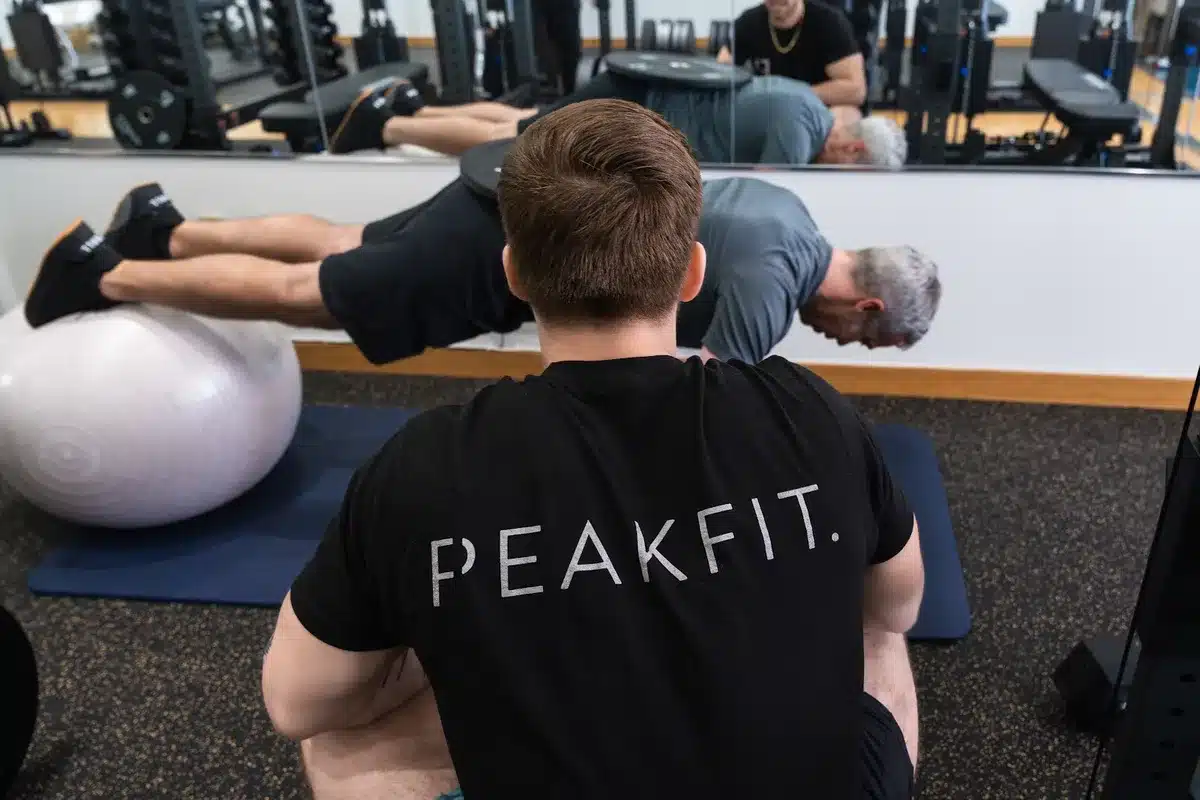
The assessment is observational and non-invasive. Your trainer watches you perform a series of fundamental movements: an overhead squat, a single-leg squat, a push and a pull, a hip hinge, and a rotation. At bodyweight, with no load.
Each movement reveals specific information. The overhead squat, for example, shows hip mobility, thoracic extension capacity, shoulder flexibility, and core stability simultaneously. A trained eye can identify multiple deficits from a single movement pattern.
From the assessment, the trainer produces a list of priorities. Not everything gets addressed at once — the most clinically relevant compensations are addressed first, with others folded in as the primary issues resolve.
The corrective phase runs concurrently with the early training phase, not before it. You’re building strength and learning correct movement at the same time. The corrective elements appear as part of the warm-up, as exercise substitutions, or as accessory work alongside the primary training movements.
Dakota Hall’s background as a certified flexologist complements corrective exercise work significantly at PEAKFIT. Assisted stretching sessions address the tissue restrictions identified in the assessment — hip flexor tightness, thoracic stiffness, shoulder restrictions — that need direct intervention before movement patterns can fully change. You can see more about the full PEAKFIT team here.
Frequently Asked Questions
Do I need corrective exercise if I’ve never had an injury? Yes. Movement compensations develop from sedentary habits, repetitive daily movements, and past minor incidents that never caused significant pain. The absence of injury doesn’t mean the absence of dysfunction. Most adults who’ve never had a movement assessment discover at least one compensation they weren’t aware of.
How long does the corrective phase of a program last? It depends on the severity and number of issues identified. Minor compensations often resolve within four to eight weeks of targeted work. More significant restrictions may take longer, particularly if they involve both mobility and strength deficits. The goal is always to progress to full loading as efficiently as the body’s response allows.
Is corrective exercise the same as physical therapy? No. Physical therapy is a licensed clinical intervention for diagnosed conditions. Corrective exercise is a fitness methodology applied to sub-clinical movement dysfunction in apparently healthy people. There is overlap in tools and concepts, but they operate in different scopes of practice.
What if I’ve had an injury and my PT cleared me? PT clearance means you’re safe for general activity, not that all movement compensations have been resolved. Post-PT clients at PEAKFIT often benefit significantly from a corrective exercise phase that addresses patterns that developed during the protected recovery period.
Can corrective exercise help with chronic back or joint pain? Often yes, particularly when the pain is associated with movement dysfunction rather than structural damage. Addressing the underlying compensations that place excessive stress on pain-sensitive structures is a core application of corrective exercise in the fitness context. A trainer should work collaboratively with your healthcare provider for any persistent pain situation.
Starting any program the right way means starting with an assessment. Schedule your free consultation at PEAKFIT Studio in Arden, NC and find out exactly where your movement is strong and where it needs attention before loading begins.
PEAKFIT Studio 100 Julian Ln, Suite 120 | Arden, NC 28704 (828) 620-7020 | hello@peakfit.studio






Luxury Personal Trainer Asheville NC: High-Touch Fitness Coaching
Key Takeaways A luxury personal trainer in Asheville NC delivers a fundamentally different experience from a standard gym membership: individualized
Functional Movement Training Asheville NC: Move Better, Live Longer
Key Takeaways Functional movement training focuses on the patterns your body uses every day, such as bending, reaching, carrying, and
Senior Fitness Training Asheville NC for Adults 60 and Up
Key Takeaways Senior fitness training in Asheville NC addresses the specific physical changes that come with aging, including muscle loss,