
Key Takeaways
- Training without addressing nutrition, sleep, and recovery consistently produces slower results and higher injury rates
- Research published in the British Journal of Sports Medicine shows integrated wellness programs — combining exercise, nutrition, and recovery — outperform exercise-only programs in both outcomes and long-term adherence
- A holistic approach treats fitness as an ecosystem: every part affects the others
- The most common reason people plateau is not lack of effort — it’s lack of support across the other variables that determine how the body responds to training
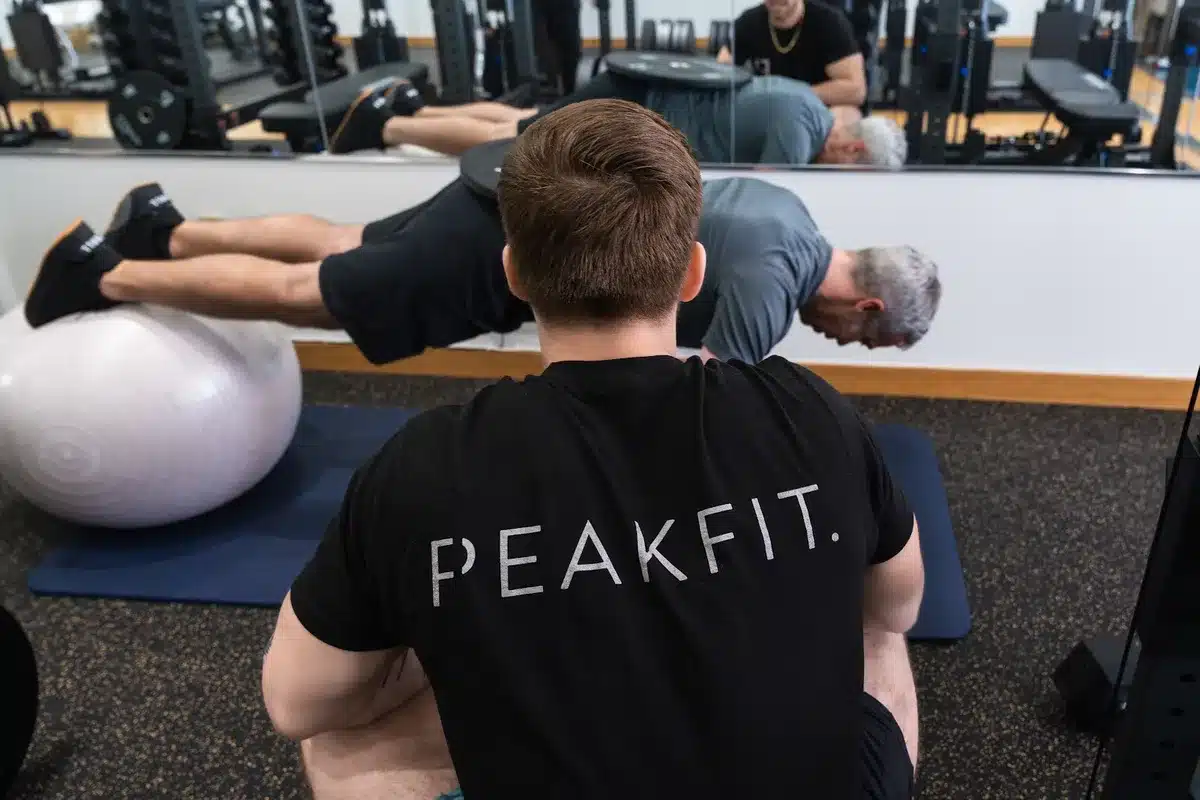
- PEAKFIT Studio’s 360 approach addresses training, nutrition, recovery, and mindset under one roof in Arden, NC

Most people approach fitness the same way: find a workout program, follow it, and hope the results come. Sometimes that works, at least for a while. But for most adults, especially those over 40, the workout alone is rarely enough. The body’s response to exercise depends on what happens outside the gym just as much as what happens inside it.
What Holistic Fitness Actually Means
Holistic fitness isn’t a buzzword. It means treating your health as an interconnected system rather than a collection of independent problems. You can’t train hard and recover poorly and expect the same results as someone who trains hard and recovers well. You can’t follow a solid workout program while eating in a way that undermines your energy and muscle repair, and expect to progress at the same rate as someone whose nutrition actually supports their training.
The variables that determine how your body responds to exercise include training stimulus, nutrition and protein availability, sleep quality and duration, stress levels, hydration, and recovery practices. A program that addresses all of those variables outperforms one that addresses only the training piece.
The ACSM’s position stand on physical activity for adults explicitly notes that nutrition and sleep are critical co-factors in exercise adaptation. Without them, the training signal is present, but the body’s ability to respond to it is compromised.
The Problem With Isolated Approaches
Isolated approaches fail for a predictable reason: they create a ceiling. You can only improve so much through any single variable. Increase your training volume while sleeping five hours a night and you get diminishing returns. Follow a precise meal plan while skipping recovery work and your joints and connective tissue eventually push back.
Most plateaus aren’t caused by insufficient training. They’re caused by a mismatch between training load and recovery capacity. Research published in Sports Medicine found that inadequate sleep reduced strength gains by roughly 20% in resistance training subjects compared to a matched group that maintained adequate sleep. That’s not a small effect. Twenty percent is the difference between consistent progress and spinning your wheels.
Stress is another overlooked factor. Chronically elevated cortisol, the primary stress hormone, directly competes with testosterone and growth hormone — both essential for muscle repair and body composition. Adults in demanding professional or personal environments often find that adding more training volume makes things worse, not better, because the total stress load on the body is already high. The personal training team at PEAKFIT factors these real-life variables into every client’s program rather than applying a one-size-fits-all training load.
How Nutrition, Recovery, and Training Interact
Think of training as a signal and nutrition plus recovery as the response. Training tells your body to adapt. Nutrition provides the raw materials for that adaptation — primarily protein for muscle repair and carbohydrates and fats for energy. Sleep and recovery give your body the time and the physiological environment to actually do the rebuilding.
Skip any one of those three things and the chain breaks. Train without adequate protein and your body has limited capacity to build and repair muscle. Eat well and train consistently but sleep poorly and your hormonal environment works against you. Recover well and eat well but don’t train with enough progressive challenge and there’s no signal to respond to.
At PEAKFIT Studio, nutrition counseling and recovery services including infrared sauna and red light therapy are built into the same program as personal training. They’re not optional add-ons. They’re the other legs of the structure that makes training work. Clients who engage with the full 360 approach consistently see faster progress than those who train only.
What a 360 Program Looks Like in Practice
A typical PEAKFIT client trains two to three times per week, works with Alana or another coach on nutrition strategy, and incorporates at least one recovery session per week, whether that’s an infrared sauna session, red light therapy, or assisted stretching with Dakota. The InBody scan tracks body composition every four to six weeks so the data, not guesswork, drives program adjustments.
That’s the 360 model. Not a collection of separate services, but an integrated system where each component supports the others. When a client’s InBody scan shows muscle mass holding steady but body fat not decreasing, the nutrition conversation changes. When a client reports poor sleep for two weeks running, the training load gets adjusted to match their recovery capacity. The program responds to the whole person, not just the workout.
You can see what programs look like in practice on PEAKFIT’s programs page. The free consultation is the starting point where your trainer assesses which areas need the most attention and builds a plan accordingly.

Frequently Asked Questions
Do I have to use all of PEAKFIT’s services to see results? No. Most clients start with personal training and add services as they go. That said, clients who engage with nutrition coaching alongside training consistently report faster progress and better adherence. Start where you are and build from there.
Is holistic fitness just another term for wellness influencer content? No. The integration of exercise, nutrition, and recovery is supported by decades of research across sports science, public health, and clinical medicine. The ACSM, the American Heart Association, and the CDC all publish guidelines recognizing that physical activity outcomes are significantly influenced by nutrition and sleep.
What if I already eat well and sleep fine but still feel stuck? That’s worth exploring in a free consultation. Sometimes the issue is the training program itself — wrong type, wrong volume, or wrong recovery ratio. Sometimes it’s a nutrition gap that looks fine on the surface but has measurable effects. The InBody scan and assessment process often reveal what’s driving the plateau.
How is PEAKFIT’s approach different from a standard gym membership? A gym membership gives you access to equipment. PEAKFIT provides a trainer who designs your program, a nutrition coach who aligns your eating with your goals, recovery services that support adaptation, and objective body composition tracking to measure results. The accountability structure is entirely different.
Can someone with a chronic health condition participate in a holistic program? Yes, with appropriate modifications. Every PEAKFIT program begins with a health history review, and trainers adapt all components — including training, nutrition guidance, and recovery services — around any existing conditions.
PEAKFIT Studio’s 360 approach is available to adults in Arden, South Asheville, Hendersonville, and Fletcher. Schedule your free consultation and build a program that addresses more than just your workouts.
PEAKFIT Studio 100 Julian Ln, Suite 120 | Arden, NC 28704 (828) 620-7020 | hello@peakfit.studio






Luxury Personal Trainer Asheville NC: High-Touch Fitness Coaching
Key Takeaways A luxury personal trainer in Asheville NC delivers a fundamentally different experience from a standard gym membership: individualized
Functional Movement Training Asheville NC: Move Better, Live Longer
Key Takeaways Functional movement training focuses on the patterns your body uses every day, such as bending, reaching, carrying, and
Senior Fitness Training Asheville NC for Adults 60 and Up
Key Takeaways Senior fitness training in Asheville NC addresses the specific physical changes that come with aging, including muscle loss,