
Key Takeaways
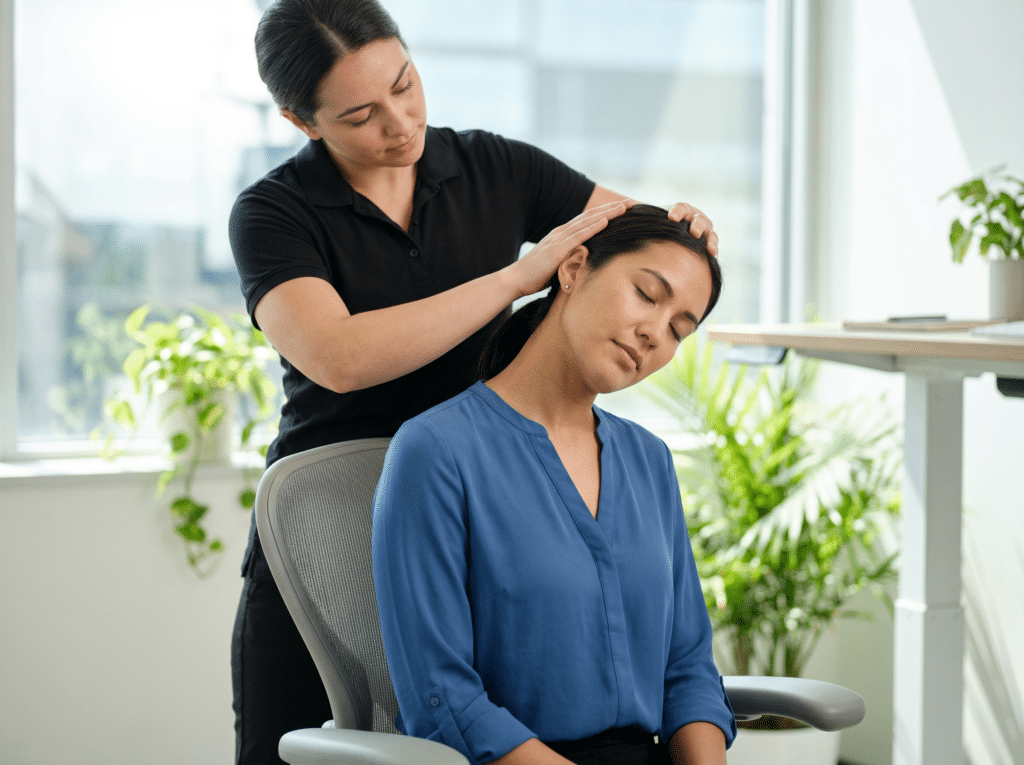
- Sitting for 6 or more hours a day produces predictable mobility restrictions: tight hip flexors, rounded shoulders, compressed thoracic spine
- PNF assisted stretching produces greater flexibility gains than static stretching alone — research shows 10% or more improvement in hamstring flexibility over matched time periods
- PEAKFIT Studio’s certified flexologist Dakota Hall specializes in the movement restrictions that desk-based professionals develop over years
- Sessions are 30 or 60 minutes — available standalone or paired with personal training at PEAKFIT in Arden, NC
If you work at a desk, your body is adapting to that position whether you want it to or not.
Hip flexors shorten. Glutes become inhibited. Thoracic spine rounds. Pectoral muscles tighten while upper back muscles weaken. Neck extensors strain to hold your head forward over a screen. None of this happens overnight, but it happens consistently — and by the time it starts producing daily discomfort, the restrictions are often years in the making.
Static stretching helps at the margins. But for the kind of deeply embedded mobility restrictions that desk work produces, PNF assisted stretching is a different category of treatment.
The Anatomy of a Desk Worker’s Mobility Problem
Understanding the specific patterns that desk work creates helps explain why targeted intervention is worth your time and attention.
Hip flexors. Sitting keeps your hip flexors in a shortened position for hours at a time. Over months and years, the muscle fibers adapt to this shortened state, and the nervous system recalibrates its sense of “normal” range of motion accordingly. Tight hip flexors pull the pelvis into anterior tilt, compressing the lumbar spine and inhibiting the glutes — which causes a cascade of movement dysfunction that affects everything from how you walk to how you lift.
Thoracic spine. The mid-back rounds under gravity during prolonged sitting. Over time, the vertebral joints stiffen in this flexed position, and the muscles supporting upright posture become chronically fatigued or inhibited. This is why many desk workers feel tension and stiffness in the mid-back that doesn’t fully resolve with casual stretching.
Shoulders and chest. Forward head posture combined with keyboard use shortens the anterior shoulder muscles and stretches the posterior ones. The result is internally rotated shoulders, reduced overhead mobility, and often chronic tension across the upper traps.
According to research published in Applied Ergonomics, office workers who sit for more than 6 hours per day show significantly greater hip flexor tightness, reduced thoracic mobility, and elevated rates of musculoskeletal pain compared to those who sit for fewer hours (Applied Ergonomics, 2019).
Our functional movement screening service identifies exactly which restrictions are affecting your movement patterns — it’s a useful starting point if you want a full picture before scheduling targeted work.
Why Static Stretching Isn’t Enough
Static stretching — holding a stretch for 30 to 60 seconds — is better than nothing. But it works against the nervous system’s protective reflexes rather than with them.
When you stretch a muscle passively, your nervous system activates a stretch reflex that resists the elongation. This is a protective mechanism, and it doesn’t simply turn off because you’re trying to stretch. You can make progress with static stretching, but it’s slow and the gains tend to be limited.
PNF stretching works differently. The contract-relax method used by PEAKFIT’s certified flexologist Dakota Hall asks you to briefly contract the muscle being stretched against gentle resistance. After that contraction, the nervous system enters a brief inhibitory window — a natural relaxation response — during which the muscle can be guided deeper into the stretch than passive techniques allow.
Research published in Physical Therapy in Sport demonstrated that PNF stretching produced significantly greater hip flexor range of motion improvements than static stretching in desk-working adults over a six-week period (Physical Therapy in Sport, 2020). This is precisely the muscle group most compromised by prolonged sitting, and precisely where PNF produces its most meaningful results.
What a Session Addresses for Desk Workers
Dakota tailors every session based on a brief movement assessment at the start. For desk-based professionals, sessions most often address the following areas, in order of priority:
Hip flexors and anterior chain. The first priority for most desk workers. Releasing the hip flexors restores pelvic alignment, takes load off the lower back, and allows the glutes to function properly again.
Thoracic extension and rotation. Restoring mid-back mobility reduces the compensatory strain on the neck and lower back and improves shoulder mechanics.
Shoulder and pectoral flexibility. Opening the anterior shoulder improves posture, overhead range of motion, and the discomfort that comes from chronically shortened pectoral muscles.
Hamstrings. Tight hamstrings compound pelvic tilt and lower back strain. PNF work on the hamstrings is typically highly effective in a single session.
A 30-minute session covers two to three of these areas in depth. A 60-minute session allows for comprehensive work across all four, with time for a basic movement reassessment at the end.
Many clients combine assisted stretching with posture correction training for a complete approach to desk-work damage.
How Assisted Stretching Fits With Personal Training
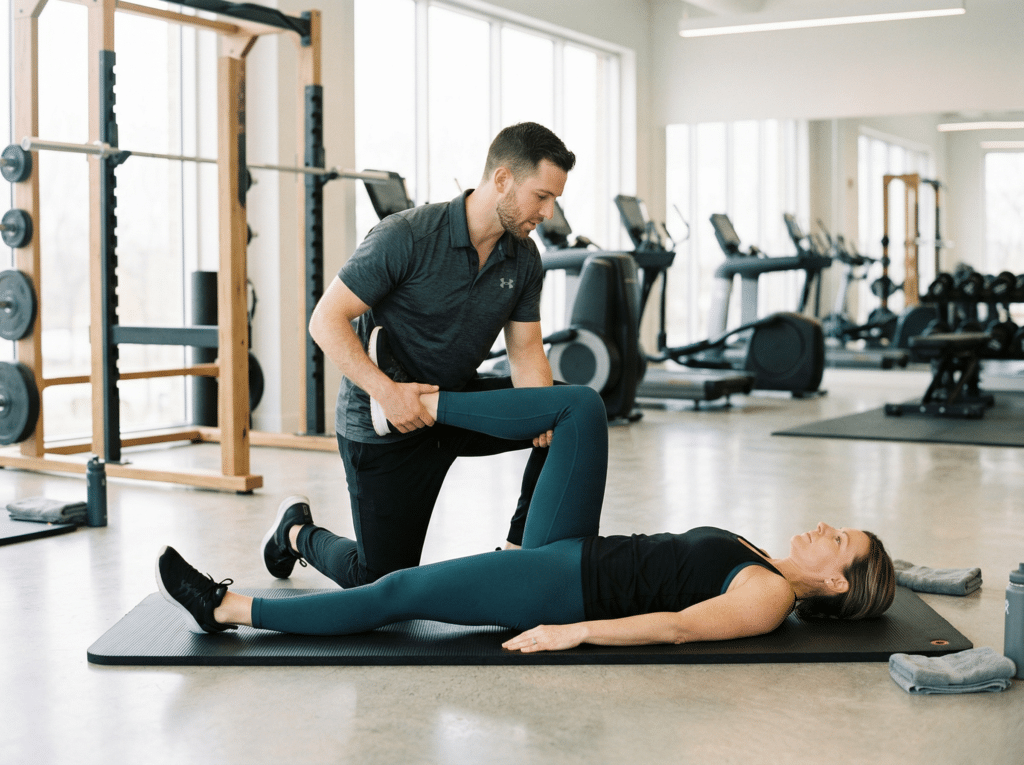
Improved mobility is not just about feeling better. It’s a direct performance multiplier.
When your hip flexors are released and your glutes can fire properly, squats, deadlifts, and lunges become both more effective and safer. When your thoracic spine rotates freely, overhead pressing and rowing patterns work as designed. When your shoulder is free, push mechanics stop recruiting the neck and upper traps as compensation.
PEAKFIT’s personal training team often refers clients to assisted stretching sessions when movement quality is the limiting factor — when someone can’t achieve proper depth in a squat, for example, or when shoulder mechanics are breaking down under load. Addressing the restriction makes the training more effective across the board.
Clients who train with PEAKFIT’s private personal training programs often schedule a monthly or bi-monthly stretching session as maintenance, with more frequent sessions during periods of heavy training volume or after long stretches of travel and sitting.
For anyone dealing with chronic tightness who hasn’t yet started a training program, assisted stretching is often the best first step — before even thinking about exercise. Resolving mobility restrictions first makes every subsequent workout more productive and lower risk.
How to Pair Stretching With Other Recovery Services
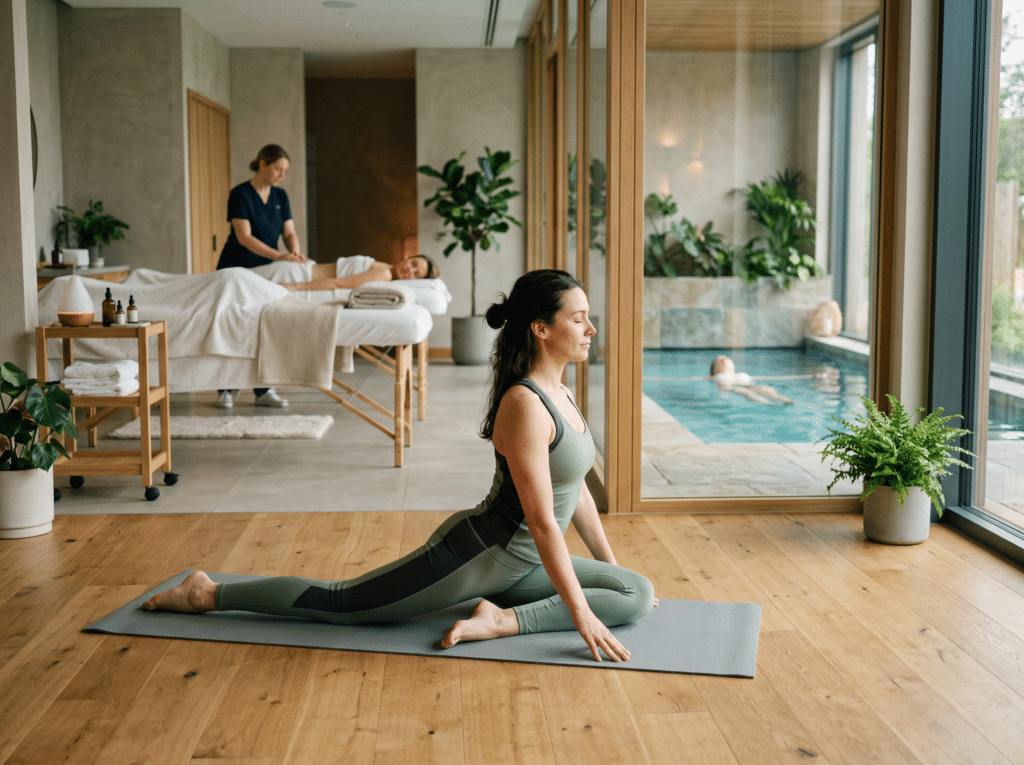
For desk workers, assisted stretching works best as part of a broader recovery and movement system.
Infrared sauna before a stretching session warms soft tissue, making muscles more responsive to PNF work and the session more comfortable overall. Many clients build this into a single studio visit: 30 minutes of sauna, then a 30-minute assisted stretching session.
Red light therapy addresses the inflammation that accumulates in chronically tight muscles and irritated joints. Pairing red light with stretching sessions — either in the same visit or on alternating days — supports faster resolution of chronic restriction patterns.
Explore the full PEAKFIT recovery and wellness service menu and see how each tool fits into a complete plan for desk workers and busy professionals.
Frequently Asked Questions
How many sessions before I notice a real difference?
Most clients notice improved range of motion immediately after their first session. Lasting changes — where the new mobility holds between sessions and carries over into daily movement — typically require four to six sessions for deeply embedded restrictions. The longer the restriction has been present, the more sessions it generally takes to reset the baseline.
How often should desk workers get assisted stretching?
For someone with significant mobility restrictions, once a week is a good starting frequency for the first four to six sessions. After reaching a functional mobility baseline, monthly maintenance sessions are typically enough — unless you’re in a period of especially heavy sitting (long work projects, frequent travel, back-to-back meetings).
Can I combine a stretching session with my personal training workout the same day?
Yes. Many PEAKFIT clients train with their personal trainer and then finish with a 30-minute stretching session. The order can go either way: some clients prefer to stretch before training to improve movement quality during the session, while others prefer to stretch after as part of their cooldown and recovery.
My lower back has been bothering me for years. Will this help?
Lower back pain in desk workers is most often a mobility and alignment problem, not a structural one — and the hip flexor and thoracic patterns described above are common contributors. That said, if your back pain is diagnosed as a disc injury or other structural condition, discuss assisted stretching with your physician or physical therapist before booking. Our team at PEAKFIT is happy to discuss your situation during a free consultation.
Do I need any experience with stretching to benefit from PNF?
None at all. Dakota guides you through every contraction and relaxation cue. You don’t need any prior knowledge of stretching techniques or muscle anatomy. Many of PEAKFIT’s stretching clients have never done anything beyond a basic post-workout stretch.
Book Your First Stretching Session at PEAKFIT
PEAKFIT Studio is at 100 Julian Ln, Suite 120, Arden, NC 28704. We’re minutes from South Asheville, Hendersonville, and the Fletcher/Airport corridor — easy to reach before or after work. Call (828) 620-7020 or book online to get started.
Standard sessions are $49 for 30 minutes and $79 for 60 minutes. See all services and pricing.




PEAKFIT x Athleta: Free Community Strength Class — July 25, 2026
Arden’s Only Private Personal Training Studio for Adults 40+ PEAKFIT Studio and Athleta are partnering for a free community strength
Finding the Right Gym Near Me in Arden: Your Complete Guide
Key Takeaways Choosing the right gym isn’t just about proximity—it’s about finding a space that matches your fitness goals, comfort
Personal Training for Busy Executives in Arden NC That Works
Key Takeaways Personal training for busy executives does not have to mean hour-long sessions five days a week. At Peak