
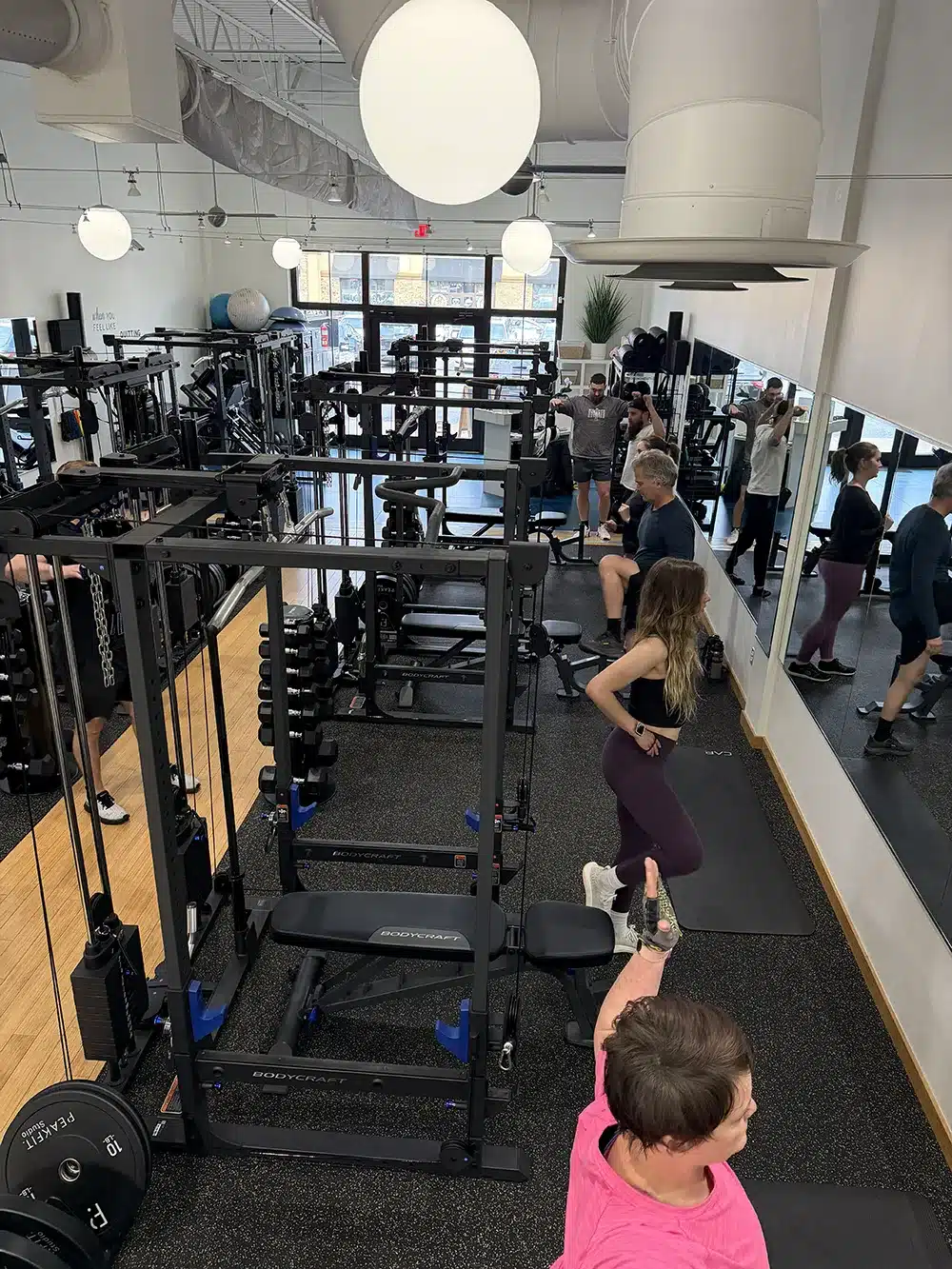
TL;DR: Bringing a friend into small group training is one of the most reliable ways to actually keep a fitness habit. A workout buddy turns “I should go” into “they’re expecting me,” and the research on exercise adherence is overwhelmingly on your side: people who train with someone show up more, quit less, and push harder. In a coached small group in Asheville, you get that social glue plus professional programming — the combination that makes training stick for years, not weeks.
What This Guide Covers
- Why a workout buddy changes everything
- What the science says about training with a friend
- Why a small group beats a one-on-one buddy system
- Who to bring (and who not to)
- How to start with a friend at PEAKFIT
- FAQ
Almost everyone has a story about a fitness plan that started strong and quietly died. Usually it died alone — a solo membership, a solo treadmill, a solo decision every single morning about whether to bother. The fix is almost embarrassingly simple: stop training alone. When a friend is counting on you to show up, the daily debate about whether to go mostly disappears, and that single change is what separates people who stay fit from people who keep restarting.

Why a Workout Buddy Changes Everything
Motivation is unreliable. It is high on January 1st and gone by February. Accountability is durable, because it does not depend on how you feel that morning — it depends on a commitment to another person. A friend in your session means a missed workout is a missed appointment with someone real, and most of us will keep a promise to a friend long after we have broken every promise to ourselves.
There is also a pace effect. Training next to a friend who is working hard quietly raises your own effort. You finish the last set you would have skipped. You add the extra rep. None of it feels like willpower — it feels like company.
Section summary: A friend converts unreliable motivation into durable accountability, and their effort naturally lifts yours.
What the Science Says About Training With a Friend
Exercise adherence — sticking with it over months — is the strongest predictor of results, and social support is one of the most consistent drivers of adherence in the research. People who exercise with others report higher enjoyment, train more often, and are far less likely to drop out than solo exercisers. The benefit is partly emotional and partly structural: a shared schedule removes the friction of deciding alone.
The payoff matters more with age. Adults lose roughly 3–8% of muscle per decade after 30, and consistent strength training is the proven countermeasure — but only if you actually keep doing it. A friend is, functionally, a muscle-preservation strategy. National guidance recommends two strength sessions per week (Physical Activity Guidelines for Americans), and you are far more likely to hit that with someone beside you.
Section summary: Social support is one of the best-documented predictors of sticking with exercise — and consistency is exactly what protects strength as you age.
Why a Small Group Beats a Solo Buddy System
Two friends working out together with no plan still hit the same wall as anyone else: form drifts, progress stalls, and one person ends up “leading” while the other coasts. A coached small group keeps the accountability of a buddy while adding the things friends can’t give each other — a professional eye on your mechanics, a program that gets measurably harder over time, and zero arguments about what to do today. It is the difference a lot of members describe in the benefits small group training delivers that solo workouts can’t match.
A small group also widens the social net. You came with one friend; you leave knowing four people who now expect to see you Thursday. That web of mild social obligation is, unglamorously, one of the most powerful retention tools in fitness.
Section summary: A coached small group keeps the buddy accountability and adds professional programming plus a wider web of people who expect you.
Who to Bring (and Who Not To)
The best training partner is someone whose schedule overlaps yours and who takes the commitment seriously — not necessarily your fittest friend. Matched fitness levels are a bonus but not required, because a good coach scales each person’s load and complexity inside the same session. Avoid bringing someone who treats workouts as optional; their flakiness becomes your excuse. If you and a partner want this dynamic with even more shared structure, that’s exactly what couples personal training is built around.
Section summary: Pick a reliable friend with an overlapping schedule; matched fitness helps but the coach handles the rest.
How to Start With a Friend at PEAKFIT
It is straightforward. You and your friend each start with a quick goals conversation, an InBody scan to set real baselines, and a movement assessment so the coaching fits your bodies. Then you train together in the same session, progress on your own curves, and re-test so you can both watch the numbers move. New to all of this? Here’s how to find quality small group personal training near you so you know what good looks like.
Section summary: Start with goals, an InBody baseline, and a movement assessment for each of you, then train together while progressing individually.
Frequently Asked Questions
Do my friend and I need to be at the same fitness level?
No. A coach scales load, range of motion, and complexity for each person inside the same session, so you can train side by side at very different levels and both be challenged appropriately.
Is small group training with a friend cheaper than a personal trainer?
Yes. Per-person small-group rates are lower than one-on-one personal training, so you get hands-on coaching at a more accessible price while keeping the accountability of a friend.
What if my friend flakes out after a few weeks?
You keep going. By then you’ll know others in your group who expect to see you, which is exactly why a small group is more durable than a two-person buddy system.
How many sessions a week should we aim for?
Two per week is the sweet spot for most people — enough to build real strength and meet national guidance while staying realistic for busy schedules.
Can we bring more than one friend?
Absolutely. Small groups are built for exactly this. More familiar faces usually means even better attendance.
Better With a Friend.
Grab a friend and book a consultation at PEAKFIT Studio in Arden, NC. We’ll set baselines for both of you and build a plan you’ll actually keep — together.
Key Takeaways:
- A workout buddy turns unreliable motivation into durable accountability.
- Social support is one of the strongest predictors of sticking with exercise.
- A coached small group keeps the buddy effect and adds real programming and form feedback.
- Pick a reliable friend with an overlapping schedule; the coach handles fitness-level gaps.


The Asheville Detox: How Juicing and Nutrition Reset Your Summer
Most summer detox content is junk. Here’s what a real 10-day reset actually looks like for adults over 40 in
Couples Personal Training in Asheville: Why Training Together Works
Couples who train together in a coached small-group setting stick with it longer and see better results. Here is why
Rock Climbing Training Pisgah Forest: Build Strength for WNC Peaks
Key Takeaways Rock climbing in Pisgah Forest demands specific strength, endurance, and movement patterns that general gym workouts simply can’t