The Case for Slowing Down: Why Rest Days Are a Non-Negotiable After 45
The most counterintuitive truth in fitness after 45 is that you make progress on rest days, not on training days. Training is the stimulus. Recovery is where the adaptation actually happens. Skip the recovery, and the stimulus has nowhere to go.
Younger lifters can get away with abusing this principle. After 45, you cannot. The biology is different, the costs are higher, and the line between productive training and accumulated fatigue is thinner. Here is what is actually happening when you do not rest enough, and how to structure recovery that drives results.
Recovery is not the opposite of training. It is the back half of every training session.
What chronic under-recovery does to your hormones
The endocrine system is built to handle stress in pulses. A hard training session is a productive stressor — it triggers a cascade of hormonal responses (cortisol, adrenaline, growth hormone, testosterone) that, given adequate recovery, drive adaptation: more muscle, denser bone, better insulin sensitivity, sharper cognition.
The problem starts when stress becomes chronic instead of pulsed. If you train hard six days a week without enough rest, your cortisol stays elevated through the day instead of spiking around training and dropping. Chronic elevated cortisol catabolizes muscle, drives visceral fat storage, suppresses testosterone, disrupts sleep, and quietly tanks recovery from every subsequent session.
After 45, this happens faster and with smaller training loads than it would have at 25. The same volume that built muscle in your 30s now degrades it.
The CNS fatigue tax
Heavy compound lifts — squats, deadlifts, presses, rows — tax your central nervous system in a way that lighter accessory work does not. The CNS recovers slower than muscle. You can feel muscularly recovered, ready to lift again, while your CNS is still depleted from the previous session.
The signs are subtle: weights feel heavier than they should, top-end power drops, coordination is slightly off, motivation feels low even when life is good. This is not laziness. It is a depleted nervous system that needs 48 to 72 hours, not 24, to reset between heavy sessions.
Sleep quality is the recovery multiplier
This is the piece most over-40 trainees miss. Total sleep time matters, but sleep quality matters more. Deep sleep (slow wave sleep) is when growth hormone is released and tissue repair is most active. REM sleep handles cognitive recovery and emotional processing.
Chronic under-recovery actively damages sleep quality. Elevated evening cortisol fragments sleep, suppresses deep sleep, and disrupts REM. The result is a vicious cycle: you do not recover well, so sleep gets worse, so you recover even less well from the next session.
How to structure a real recovery week
The most useful template for adults over 45 is something like:
3 strength sessions per week — never two in a row, always at least one day between hard lifts
2–3 active recovery days — walking, easy cycling, mobility work, gentle yoga, zone two cardio
1–2 full rest days — no structured exercise, just life
A week might look like: Monday lift, Tuesday walk, Wednesday lift, Thursday rest or sauna, Friday lift, Saturday active (hike, bike, swim), Sunday rest. The total stimulus is high enough to drive adaptation. The recovery is built in, not hoped for.
Why an active recovery day is not a rest day
The distinction matters. Active recovery means low-intensity movement that increases blood flow and supports tissue repair without adding training stress: easy walks, light cycling, mobility work, foam rolling, zone two cardio. Cortisol stays low. Heart rate stays in conversation territory.
Rest days are different. They are intentionally low-stimulus. Sleep in. Take it easy. Do not even count steps. The body uses both, and they are not interchangeable. Over a week, the right mix of training, active recovery, and full rest is what produces the adaptation.
Tools that accelerate recovery
A handful of inputs make a measurable difference in recovery quality:
Protein. 0.7 to 1.0 grams per pound of bodyweight per day, spread across meals.
Sleep hygiene. Consistent bedtime, dark room, no screens 30 minutes prior, no caffeine after noon.
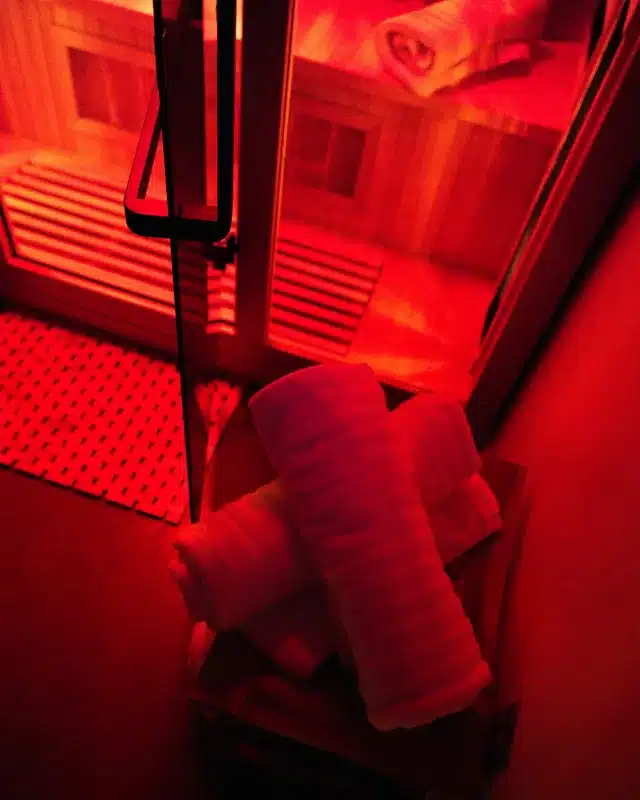
Infrared sauna. 20–30 minute sessions, two to four times a week, support heat shock proteins, parasympathetic recovery, and cardiovascular health.
Red light therapy. Solid evidence for accelerated muscle recovery, reduced inflammation, and improved sleep onset.
Daily walking. 7,000+ steps a day, separate from training, supports parasympathetic tone and circulation.
This is where PEAKFIT’s infrared sauna and red light therapy services earn their keep — not as bells and whistles, but as deliberate recovery tools that make the training you are doing work harder for you.
The reframe
If you take one idea from this, take this one: rest days are when the program works. The lift is the order. Sleep, walking, sauna, mobility, food — that is the kitchen actually cooking the meal.
If you are training hard, plateauing, and feel like you are running on empty, you almost certainly do not need to add training. You need to add recovery. Build a real week, with built-in recovery, and the body you have been chasing shows up.