

There is a quiet belief most people carry into their 60s about exercise: that it is too late. That the best gains were behind them. That whatever they do now is damage control rather than building. The conventional advice does not help. Stay active. Be careful. Don’t overdo it.
Almost all of that is wrong. Not gently wrong — completely wrong. Personal training at 60 is often more effective than personal training at 30. Not equally effective, accounting for biology. More effective. Here is why.
1. You actually do what you are told
The single biggest variable in training results is compliance. Are you doing the program, on the days you said you would, with the effort the program requires? At 30, most clients miss sessions, freelance the exercises, skip the boring parts, and add the parts they like. At 60, most clients show up, do exactly what the trainer wrote, and ask before they change anything.
This sounds like a small thing. It is not. A perfectly compliant client on an average program outperforms a non-compliant client on a perfect program by a wide margin. Adherence is the whole game, and it favors the older client.
2. You have stopped lying to yourself about effort
Younger clients tend to misjudge intensity in both directions — either they overstate how hard they pushed (ego) or they understate how tired they are (also ego). Older clients are usually honest. They will tell you when something felt off, when sleep was bad, when a knee is acting up, when energy was a six instead of an eight.
Honest feedback is gold for a trainer. We can program around an honest report. We cannot program around what you wish were true.
3. Your body awareness is dramatically better
By 60, you have lived in your body long enough to know it. You can tell the difference between productive muscle soreness and a joint complaint. You can feel when a movement is loading in the right place versus the wrong place. You know when you need more sleep, more food, or more recovery.
A 30-year-old client often cannot tell the difference between sore and injured. A 60-year-old client almost always can. That makes coaching cues land faster and form corrections stick.
4. Your motivation is real, not aesthetic
The reason a 60-year-old walks into a personal training session is not to look better in a swimsuit. It is to play with grandkids without their back hurting. To carry their own suitcase through an airport at 80. To not be the parent who needs help getting up. These are durable motivations. They do not fade in February. They do not depend on a mirror.
Aesthetic goals are fragile. Function goals are not. Clients with function goals stick with programs for years, and the compound interest of years of consistent training is what actually transforms a body.
5. Adaptation is alive and well after 60
The medical literature is now clear, even though the cultural belief lags. Untrained adults in their 60s and 70s gain strength at roughly the same relative rate as untrained adults in their 20s and 30s. Hypertrophy is slower, but still meaningful — especially with proper protein intake and progressive overload.
You do not get back to your 25-year-old peak. But you can be substantially stronger and more capable than you have been in 20 years. The biology does not stop working. The myth that it does is the most expensive myth in fitness.
6. The cost of skill is paid down
Most 30-year-olds in a training session are still learning what their body can do. They are still figuring out form, breathing, bracing, pacing. Time is spent on skill acquisition.
A 60-year-old with even modest training history brings decades of motor learning into the session. Even a sedentary 60-year-old picks up patterns faster than a sedentary 22-year-old because the underlying physical literacy is there. Less time on basics, more time on actual training.
What good training at 60 looks like
The training itself is not radically different. The major patterns — squat, hinge, push, pull, carry, rotate — are the same. The intensity is high enough to drive adaptation. What changes is the management around it: recovery emphasis, sleep prioritization, protein intake, joint-friendly variations of the same patterns, smarter progression timelines.
It looks like:
- Two to three quality strength sessions per week, full body
- Daily walking or zone two cardio for cardiovascular health
- Real attention to sleep, protein, and stress — not optional
- Modalities like infrared sauna and red light therapy for recovery and circulation
The honest truth about the upside
If you start serious personal training at 60, you can reasonably expect to feel ten years younger within six months. Not metaphorically — functionally. Stairs are easier. Sleep is better. Energy is steadier. The body holds itself differently. People will comment, and you will not have to say what changed.
If that sounds like what you want, book an intro at PEAKFIT. We have built our coaching specifically around adults who are not interested in fads, who want to be stronger and more capable for the next 30 years, and who are willing to do the work.





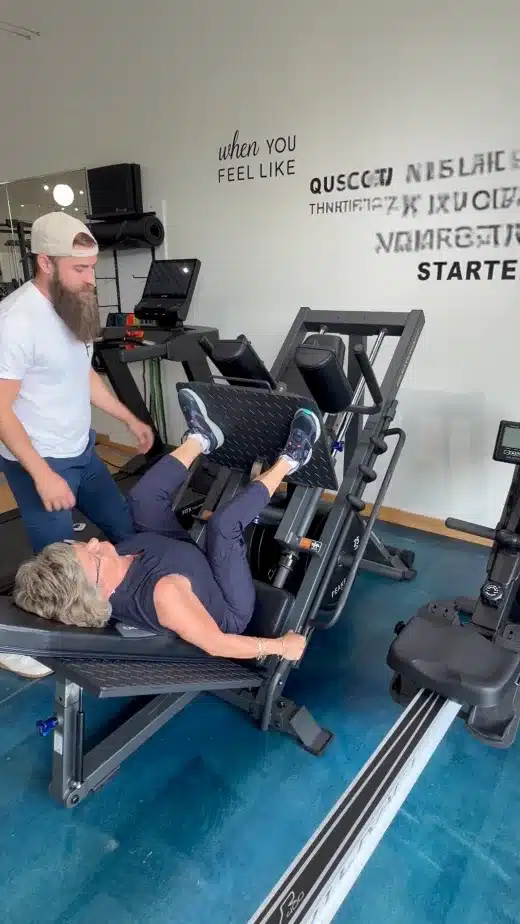


Marilyn’s Story: At 82, She Joined PEAKFIT to Lift Her Own Carry-On
Arden’s Only Private Personal Training Studio for Adults 40+ Marilyn had a very specific goal when she walked into PEAKFIT
Antioxidants and Exercise: Why Adults Over 40 Need More (and Where to Get Them)
Arden’s Only Private Personal Training Studio for Adults 40+ Every time you exercise, your body produces free radicals — unstable
Asheville Mountain Lifestyle Fitness That Supports Your Adventures
Key Takeaways Living an active mountain lifestyle in Asheville means your fitness needs to keep up with you, not the