
Balance Exercises for Fall Prevention
Last Updated: February 2026 | Topic: Senior Fitness | Location: Arden & Asheville, NC
Key Takeaways
|

If you are an adult over 40 living in Arden, Asheville, or the surrounding WNC area, balance exercises for fall prevention may be the single most important fitness work you can do right now. One in four Americans over 65 falls each year, and three million seniors visit emergency rooms for fall-related injuries annually at a cost exceeding $50 billion to the U.S. healthcare system (CDC, 2024). Behind those numbers are broken hips, head injuries, lost independence, and the start of a physical decline that is far easier to prevent than to reverse. The good news: targeted balance training programs reduce fall risk by 23-28%. The exercises are straightforward, progressive, and require no special equipment to begin. This guide explains how balance works, why it changes with age, what exercises actually help, and how the team at PEAKFIT Studio in Arden, NC builds fall prevention into every senior training program.
Why Fall Prevention Deserves Your Attention Now
Falls are not a normal part of aging that you simply accept. They are a measurable risk with proven, trainable solutions. Understanding the scale of the problem explains why prevention deserves serious attention before the first incident, not after.
According to the CDC, over 36,000 older adults die from fall-related injuries each year, making falls the leading cause of traumatic brain injuries in this age group. About 95% of hip fractures are caused by falls, and the average cost of a fall-related hospitalization exceeds $35,000. Once you fall, your risk of falling again doubles. Falls create a cascade: injury limits mobility, reduced mobility leads to muscle weakness, and muscle weakness makes the next fall more likely. Breaking that cycle is exactly what structured programming at a facility like PEAKFIT Studio is designed to do.
There is also a less visible side to this. Many adults who have never fallen develop a significant fear of falling anyway. That fear leads people to stop walking outside, avoid stairs, and limit social outings. Activity restriction causes physical deconditioning, which actually raises fall risk. The fear becomes self-fulfilling. Structured balance exercises for fall prevention address this directly by building real physical confidence. When you have practiced challenging your stability in a safe setting with a qualified trainer, the anxiety shrinks and your activity level rises. You can read more about how the PEAKFIT team approaches this in their overview of what real senior fitness coaching looks like.
How Balance Works and Why It Changes After 40
Balance seems automatic until the day it does not. Understanding the three systems that keep you upright helps clarify why stability changes with age and what you can actually do to slow that process.
Your balance depends on constant communication between three sensory systems.
- Visual system: Your eyes tell you where you are in relation to your surroundings, whether the floor is level, where obstacles are, and how fast you are moving through space. Stand on one foot with your eyes closed and you will notice immediately how much vision contributes.
- Vestibular system: Located in your inner ear, this system detects head position and movement. It tells you whether you are upright, tilted, or rotating. Problems here cause the vertigo and dizziness many older adults experience.
- Proprioceptive system: Sensors in your muscles, tendons, and joints tell your brain where your body parts are without you having to look. This is what lets you walk down stairs without staring at your feet.
Your brain constantly integrates all three data streams. When one system provides unreliable information, the others compensate. When two systems conflict, confusion and loss of balance follow.
All three systems change with age, though the decline is neither uniform nor inevitable. Vision changes include reduced depth perception and worsening contrast sensitivity, making it harder to spot edges and steps in low light. The vestibular system loses hair cells in the inner ear over time and nerve transmission slows. Proprioceptive sensors in muscles and joints become less sensitive, which is why balance challenges increase on uneven surfaces. The encouraging part: these systems remain trainable well into your 70s. Regular balance exercises improve function across all three and, critically, improve your brain’s ability to integrate what it is receiving. That is why the full-body approach to senior fitness produces better results than any single exercise practiced in isolation.
Balance Exercises for Fall Prevention: Three Levels That Actually Work
Effective balance training starts where you are today and builds in a logical sequence. Skipping ahead before establishing a foundation is how people get hurt. The three levels below reflect how trainers at PEAKFIT structure progression for adults in Arden, Asheville, and the surrounding WNC communities.
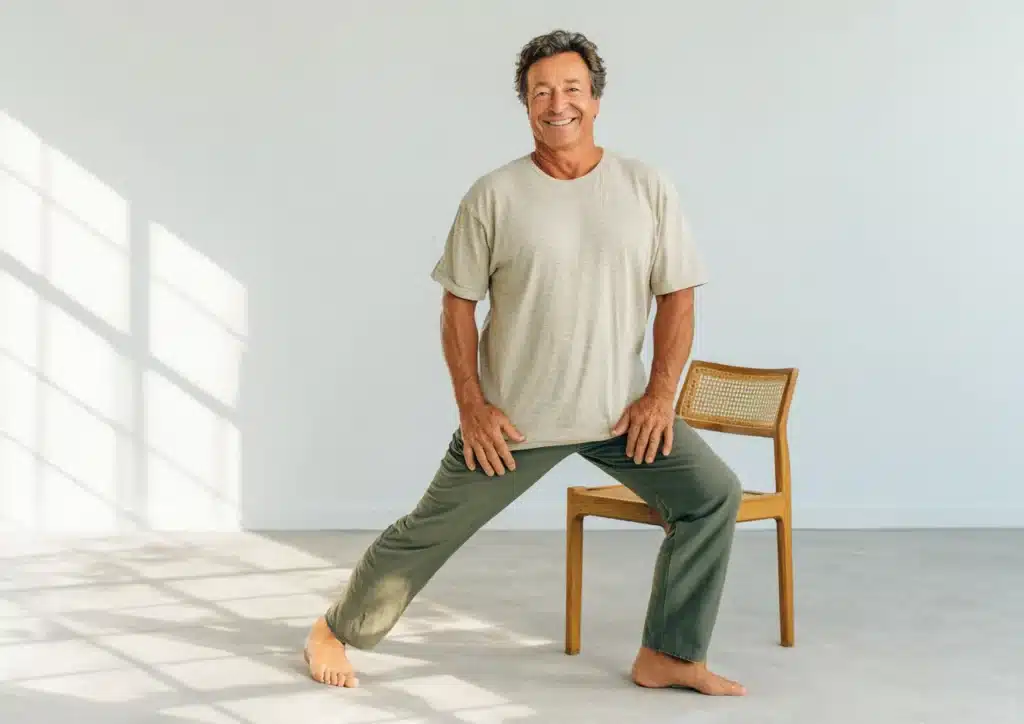
Level 1: Beginner (Chair-Supported Exercises)
If you are new to balance training or have significant stability concerns, start here. All Level 1 exercises use a sturdy chair or counter for support. Consistency at this level matters more than pushing toward the next one before you are ready.
- Supported heel raises: Hold the back of a chair and rise onto your toes, then lower slowly. This strengthens your calves and challenges ankle stability. Start with 10 repetitions and work toward 15-20.
- Supported single-leg stance: Hold the chair back and lift one foot slightly off the ground. Hold 10 seconds, then switch. Progress by reducing your grip from two hands to one hand to just fingertips.
- Supported hip circles: Hold the chair and make small slow circles with your hips, feet planted. This challenges weight shifting and hip mobility at the same time.
- Supported marching: March in place while holding the chair. Lift your knees as high as is comfortable. Slow the movement down to make it harder, not faster.
Most people can complete these exercises in 10 to 15 minutes. At this stage, five consistent sessions per week will produce more results than one long session.
Level 2: Intermediate (Unsupported Standing Exercises)
Once you can complete Level 1 without holding on, move to unsupported standing work. Keep a chair nearby for safety, but resist using it unless you actually need it. This is where meaningful gains in day-to-day stability start to show up.
- Tandem stance: Stand with one foot directly in front of the other, heel to toe. Hold 30 seconds, then switch which foot leads. The narrow base of support significantly increases the challenge.
- Single-leg stance: Without support, lift one foot and hold. Start with 10 seconds per side and work toward 30. Turn your head slowly side to side while balancing to add a vestibular challenge.
- Heel-to-toe walking: Walk in a straight line placing the heel of one foot directly in front of the toes of the other for 10 to 15 steps. Progress to walking along a strip of tape on the floor.
- Eyes-closed variations: Once you are comfortable with the exercises above, try them with your eyes closed while standing near a wall. Removing visual input forces greater reliance on your vestibular and proprioceptive systems.
These exercises pair well with the posture work outlined in PEAKFIT’s posture correction program, since good alignment and balance reinforce each other directly.
Level 3: Advanced (Dynamic and Reactive Balance)
Advanced balance training adds movement and unpredictability. These exercises train your ability to maintain or recover balance during real-world conditions, which is ultimately what matters. A stumble in a parking lot does not wait for you to be ready.
- Lateral stepping: Step sideways, crossing one foot over the other, then uncrossing. Start slow and controlled, then gradually increase pace and rhythm.
- Multidirectional reaching: Stand on one foot while reaching in different directions with the opposite hand: forward, to the side, behind you. Progress by reaching further or holding a light weight.
- Perturbation training: Working with a trainer, practice responding to gentle pushes or pulls in various directions. This trains reactive balance, the ability to recover when something unexpected happens.
- Walking with head turns: While walking, slowly turn your head to look over each shoulder. This challenges the vestibular system during forward movement.
- Obstacle negotiation: Practice stepping over and around obstacles of varying heights and positions. This trains the visual scanning and motor planning needed to avoid falls in real environments.
How Strength Training Supports Your Balance Goals
Balance exercises for fall prevention work best when they are paired with targeted strength work. Weak hips, ankles, and legs give your balance systems less to work with, no matter how well your vestibular or proprioceptive systems are functioning. Research from BMC Geriatrics found that multi-component programs combining strength and balance training reduce fall risk by 23-28%, compared to balance training alone.
At PEAKFIT Studio, the trainers working with adults in Arden, South Asheville, Fletcher, Hendersonville, Mills River, Fairview, Skyland, Biltmore Forest, and surrounding WNC communities never treat balance as a separate add-on. Strength work that supports hip stability, ankle control, and core function is woven directly into each session. If you have had a knee replacement, hip surgery, or a previous fall, programming is adjusted from the first session to meet you where you are. The goal is not to perform exercises in a gym. The goal is to walk through your life with confidence.
What to Expect at PEAKFIT Studio in Arden, NC
PEAKFIT Studio is not a big-box gym. There are no crowds, no loud music, and no one expecting you to keep up with someone half your age. The studio serves adults 40 and older in Arden and the greater Asheville area who want thoughtful, personalized programming in a calm and professional environment.
Every new client begins with a free consultation. During that conversation, your trainer learns your history, your goals, and any limitations you are working around. From there, your program is built around you, including whatever level of balance exercises for fall prevention makes sense for where you are starting. There is no generic template. There is no pressure. There is a clear plan that moves at your pace.
For clients who have had post-surgery recovery needs, mobility restrictions, or previous falls, the team at PEAKFIT has experience working alongside that reality rather than pretending it does not exist. You are treated as an intelligent adult who wants results, not a sales pitch.
Frequently Asked Questions
How often should I do balance exercises for fall prevention?
Most research supports practicing balance exercises three to five times per week for meaningful improvement in stability and fall risk reduction. Sessions do not need to be long. Ten to fifteen minutes of focused balance work done consistently will produce better results than an occasional longer workout. If you are working with a trainer at a studio like PEAKFIT in Arden, balance work is typically integrated into each session rather than saved for a separate day, which helps with consistency and keeps the training connected to your broader strength goals.
Can balance training help if I have already had a fall?
Yes, and it may be especially important in that situation. After a fall, the risk of falling again doubles, partly due to the physical effects of injury or reduced activity, and partly due to increased fear of falling. A structured program that starts at the appropriate level, moves progressively, and is supervised by a qualified trainer helps rebuild both the physical stability and the confidence needed to move through daily life without anxiety. At PEAKFIT Studio, programming for clients who have experienced a previous fall begins conservatively and advances only when the foundation is solid.
What is the difference between balance training and physical therapy?
Physical therapy typically addresses a specific injury or medical condition and is often time-limited by insurance coverage. Balance training as part of a personal fitness program is ongoing and focused on long-term strength, stability, and fall prevention rather than recovering from a specific event. The two are not in conflict. Many adults in Arden and Asheville work with a physical therapist during a recovery period and then transition to a studio like PEAKFIT to continue building on that progress in a sustained, structured way. If you are currently in physical therapy, your PEAKFIT trainer can work alongside your PT’s recommendations.
Are balance exercises safe for someone with osteoporosis?
Yes, with appropriate modifications. Balance training is actually one of the most recommended interventions for adults with osteoporosis, precisely because fall prevention reduces the risk of fractures. The key is working with a trainer who understands which movements to avoid or modify based on your bone density and any existing fracture risk. At PEAKFIT Studio, trainers work with clients who have osteoporosis regularly and design programming that challenges stability safely without putting joints or bones under inappropriate load.
Do I need special equipment to start balance exercises at home?
No. The beginner and intermediate levels described in this guide require only a sturdy chair and enough floor space to stand in. A wall nearby for safety is helpful when you first attempt unsupported exercises. As you progress to more advanced balance challenges, some exercises benefit from working with a trainer who can safely introduce perturbation training and reactive balance work that is difficult to replicate safely on your own. Starting at home with chair-supported exercises is a perfectly reasonable first step, and a free consultation at PEAKFIT in Arden can help you understand what a more structured program would look like.
Ready to Build Real Stability? Start with a Free Consultation
If you are in Arden, Asheville, South Asheville, Fletcher, Hendersonville, Mills River, Fairview, Skyland, Biltmore Forest, or anywhere else in WNC, and you want a structured approach to balance exercises for fall prevention, the team at PEAKFIT Studio is ready to help you build a plan that fits your body, your history, and your goals. You do not need to be at any particular fitness level to start. You just need to start.
Book Your Free Consultation — peakfit.studio/free-consultation/ or call (828) 620-7020