Small Group Personal Training vs Orangetheory: An Honest Side-by-Side
Orangetheory Fitness (OTF) is one of the most successful boutique fitness brands in the country, including multiple locations in the Asheville area. It is also one of the most misunderstood formats relative to its competitors. Here is what OTF actually is, what it actually delivers, and how it compares to small group personal training for adults serious about long-term results.
What OTF actually is
OTF is a 60-minute heart-rate-zone-based group fitness format. You wear a heart rate monitor. The class rotates through three blocks: treadmill, rowing, and floor work (light weights, bodyweight, TRX). The objective is to spend a target percentage of time in the “orange” and “red” heart rate zones — the high-intensity zones — to drive a metabolic afterburn effect (EPOC).
At its core, OTF is a conditioning format with a strength element. The treadmill and rowing portions are the meat. The floor work supports the conditioning rather than driving meaningful strength adaptation.
What small group personal training is
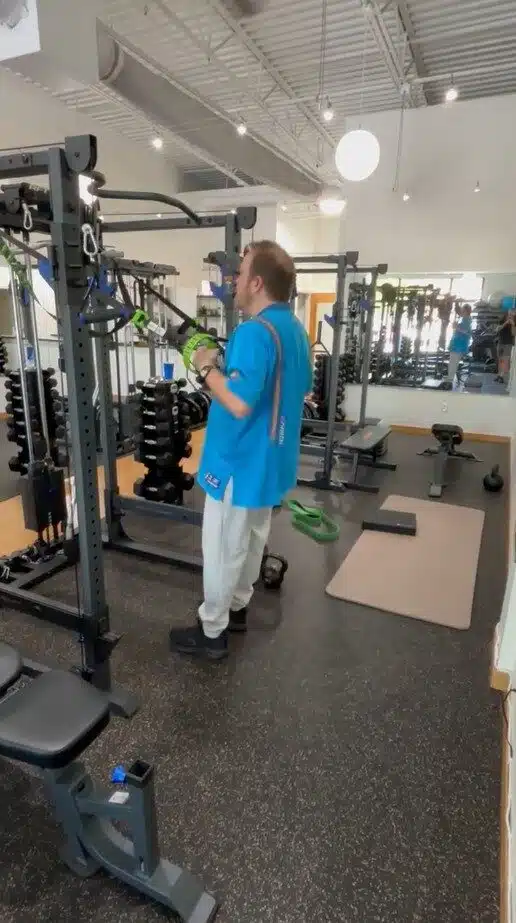
Small group personal training is the inverse. Strength training is the primary stimulus — squat, hinge, push, pull, carry — with conditioning as a supplemental finisher. Loads are progressive. Programming follows planned cycles. Twelve weeks in, you have measurably more strength, more lean mass, and better movement.
The coaching ratio gap
OTF runs at 1:24 to 1:36 per coach. The coach manages the class, calls out blocks, gives general form cues, and circulates briefly. Individual attention is structurally limited — the format is too big to receive sustained coaching.
Small group personal training runs at 1:4 to 1:8. The coach watches every set. The difference is qualitative, not quantitative.
Outcomes: where OTF wins
OTF is genuinely good at cardiovascular fitness, calorie burn during and after sessions, and the social/energy aspect of working out. For adults whose primary goal is conditioning, weight loss through cardio, or just “moving consistently in a fun environment,” OTF delivers.
Outcomes: where OTF underdelivers
OTF is structurally weak at building strength, bone density, and lean muscle mass. The floor blocks use light dumbbells (typically 8–25 lb) for high reps. There is no progressive loading from week to week on any specific lift. Adults relying on OTF as their primary strength stimulus tend to plateau on body composition after three to six months.
The over-40 strength problem
Sarcopenia — the age-related loss of muscle mass — accelerates in your 40s and continues through your 60s and 70s. The only reliably effective intervention is progressive resistance training with meaningful loads. OTF does not provide this stimulus at the intensity required.
For an adult over 40 who wants to preserve and build strength and muscle, OTF as the sole training intervention will underperform. Pairing OTF with two strength sessions per week (or doing strength-focused small group personal training instead of OTF) is the smarter approach.
Cost comparison
OTF memberships run $140–$220 per month depending on visit count. Small group personal training in the Asheville area runs $300–$500 per month for two to three sessions weekly. Cost-per-session is similar; cost-per-actual-coaching-minute is much lower in small group.
The honest verdict
If your primary goal is conditioning, calorie burn, or fun group cardio — OTF is a solid choice.
If your primary goal is building strength, body composition, bone density, or functional capacity over 40 — small group personal training will produce dramatically better twelve-month outcomes.
For many adults, the best answer is both: two small group strength sessions per week as the primary intervention, plus one OTF (or zone-two cardio) session per week for cardiovascular health.
Back to the boutique format comparison or book an intro at PEAKFIT.